
-
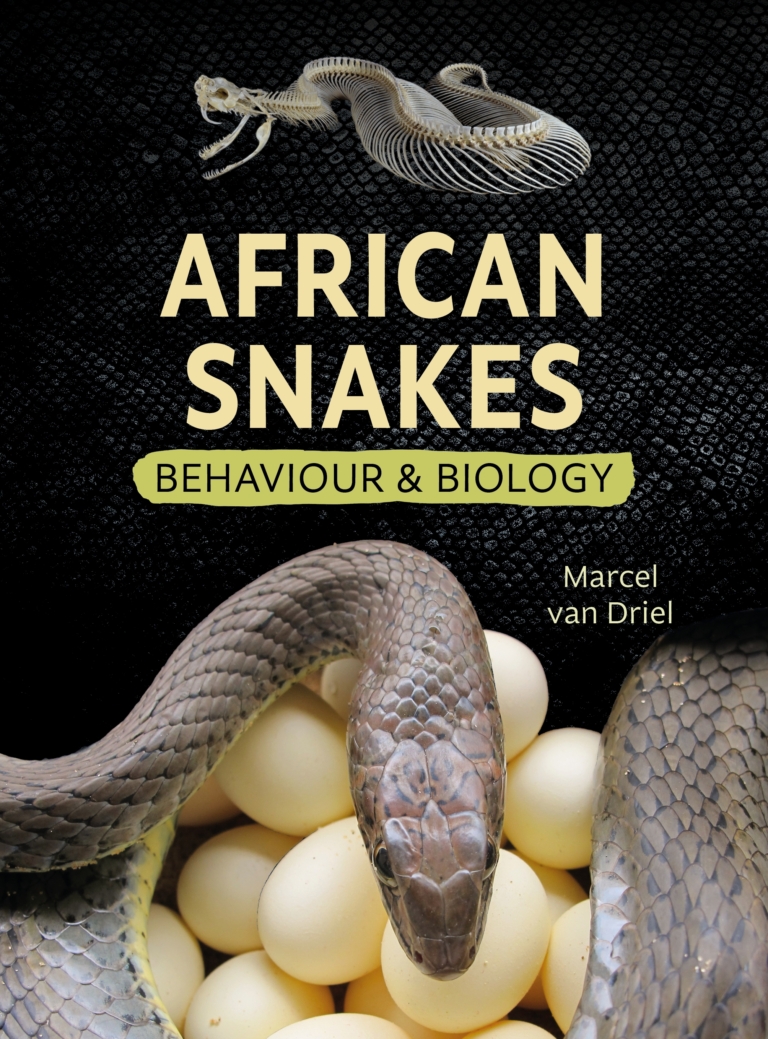
African Snakes: Behaviour and Biology
This book is also available as a paperback and eBook through Amazon UK and Amazon USA
From bush vipers to burrowing asps – snakes thrive in every habitat on the African continent. Discover how these oft-misunderstood reptiles perceive their world, defend themselves, feed and breed. This user-friendly book includes:
• The evolutionary history of snakes, with profiles of the eight families found in Africa today
• Detailed notes on inner and outer anatomy, explaining why these limbless creatures flourish in every corner of the continent
• In-depth explanations of snake behaviours, such as diverse hunting techniques and defence mechanisms
• Profiles of particularly interesting species, like the highly specialised Egg-eater and aquatic Yellow-bellied Sea Snake
• Answers to dozens of frequently asked questions: Which species is the most dangerous? How do snakes swallow prey that is larger than their head?
• Breakdown of handy diagnostic characteristics to help identify snakes in the wildR490.00R416.50 -

A Visitor’s Guide to Etosha National Park
Etosha National Park is one of Africa’s greatest wildlife sanctuaries – renowned for its stark beauty and abundant wildlife. Spanning more than 22,000 square kilometres in the semi-arid reaches of northern Namibia, it shelters a dazzling variety of mammals, birds, reptiles and other life forms, coexisting in a fragile ecosystem shaped by seasonal changes and water availability. At its heart lies Etosha Pan, the remnant of a vast inland lake, where adjacent springs and waterholes attract large herds of animals – elephants, giraffe, zebra, wildebeest, springbok, gemsbok, and the predators that follow in their wake.
While presenting a record of Etosha’s past and present, this volume also serves as a valuable guide, providing practical advice, as well as describing active waterholes and the animals that can be seen there, recommended self-drive routes for prime game viewing, and accommodation options within and beyond the park.
An indispensable companion to an unforgettable African safari.
R390.00R331.50 -

The Last Lions
Lions are the stuff of legends. Revered and feared in equal measure, both majestic and terrifying, they once reigned supreme over an extensive domain. But this once-dominant beast’s original range has contracted by some 85%, and the world population is thought to have dropped to just over 20,000 individuals. The IUCN Red Data List now classifies lions as Vulnerable, and the West African subpopulation as Critically Endangered. Not only are lion numbers crashing, but the remaining populations cling to their existence on ever smaller, more fragmented pockets of land. Feared and despised by farmers trying to eke out a living on marginal land, lions are increasingly being exterminated or repurposed for commercial gain. Trophy hunters pay extortionate sums to bag specimens in their prime, and lion bones are being sold for the roaring Eastern trade in ‘tiger wine’.
This landmark book aims to halt the downward spiral. It takes you on a journey across the continent and into the lives of rangers, scientists and communities, and the majestic creatures they work to conserve. Along with the bad news about today’s lions, it offers a message of hope, showing how innovative conservationists are rethinking our approach to human-lion coexistence.
This book, with its searing, inspiring images and vivid accounts from the experts and foot-soldiers of conservation, brings the plight of lions to the attention of the world and is an urgent plea for the actions that need to be taken before it’s too late.
Addresses the alarming state of lion populations today.
R750.00R562.50 -

Stuarts’ Field Guide to Mammals of Southern Africa
Stuarts’ Field Guide to Mammals of Southern Africa – Including Angola, Zambia & Malawi
Southern Africa has a wealth of mammal fauna, and is home to about 530 species, including tiny shrews, intriguing pangolins and majestic whales. All the species that occur in the region are featured in this updated sixth edition of Stuarts’ Field Guide to Mammals of Southern Africa.
This comprehensive guide features:
• Fully updated text based on the most recent research and taxonomy.
• Detailed species accounts describing key identification characteristics, behaviour, habitat, diet, reproduction and longevity.
• Visual identification tools, including full-colour photographs, spoor and size icons, and skull photographs.
• Up-to-date distribution maps showing the geographical range of each species within the region.The ultimate guide for identifying and understanding the mammals of the region
R600.00R450.00 -
-

Freshwater Fishes of Southern Africa – A Complete Guide
Well over 300 freshwater fish species found in the region’s rivers, lakes and dams feature in this fully revised third edition of Freshwater Fishes of Southern Africa. Updated and expanded, this definitive guide includes newly described species, the latest taxonomic changes, new photographs and illustrations, and updated distribution maps.
An in-depth introduction, supported by explanatory illustrations and photographs, covers:
• a short history of fish science in the region
• ecoregions in which species occur
• anatomy, biology and ecology of fishes
• human impacts on fishes
• conservation status
• new understanding of evolutionary relationships between different fish groups.The book also includes:
• succinct descriptions of large taxonomic groups of fish, with global distribution charts
• detailed species accounts covering size, identification features, distribution, biology, ecology, conservation, and uses by humans
• full-colour illustrations and up-to-date distribution maps for each species.An invaluable tool for anglers, students and academics in the field, and conservationists
R490.00R245.00 -

Snakes & Snakebite in Southern Africa
An essential guide to identifying all dangerous snakes in the region, as well as several commonly encountered harmless snakes, Snakes and Snakebite in Southern Africa also describes the symptoms resulting from bites and gives practical advice on first aid measures.
Now fully revised and expanded, this third edition includes nine additional species, over 250 new photographs, and the latest medical information.
Simple icons, distribution maps, succinct text and full-colour photographs make this a clear, practical and easy-to-use guide.
R320.00R240.00 -

Tracker Manual
Featuring all-new spoor drawings, some 200 new photographs, and an extra 35 species, this fully revised and updated edition of the ever-popular Tracker Manual is packed with the latest on the art of tracking. Based on information developed by some of southern Africa’s best traditional trackers, Tracker Manual gives even more guidance on how to identify the spoor of some 190 animal species. Individual chapters cover carnivores, large mammals, antelopes, small mammals, primates, hares and rodents, amphibians and reptiles, birds, and insects. Each account contains:- Simple, bulleted text on key points of each animal’s tracks
- Clear, accurate track drawings
- Numerous informative photographs, sometimes annotated
- A list of similar tracks (where applicable) to avoid misidentification.
An instructive introduction describes the science of tracking and outlines what to look for in the field, while a quick-reference table compares tracks that are easily confused. This detailed and richly illustrated manual to the region’s most common animal tracks and signs will prove invaluable in the field.R500.00R375.00 -

Wildlife of Botswana: A Photographic Guide
With its mixed terrain of desert, savanna, salt pan and river delta, Botswana is home to a wide variety of wildlife, making it a prime destination for nature and wildlife enthusiasts. Wildlife of Botswana is an easy-to-use, all-in-one guide to the country’s most conspicuous and interesting mammals, birds, reptiles, invertebrates and plants.
The book includes:
- An informative introduction to the country’s geography, climate and vegetation
- Species accounts describing each species’ appearance, habits, conservation status, habitat and best viewing localities
- Full-colour photographs of each species, along with distribution maps
An excellent portable travel companion for visitors to parks, reserves and other wildlife-rich places in Botswana
R400.00R300.00 -

Nature Now Snakes and other reptiles of Kruger
Besides being a world-famous game-viewing destination, the Kruger National Park also boasts a remarkable diversity of reptiles. This beginner-friendly guide features over 60 species of snake, lizard, terrapin, tortoise and crocodile, with basic identification pointers, interesting facts and notes on best viewing.
Learn more about the black mamba, puff adder, boomslang and other dangerously venomous snakes, as well as harmless creatures such as egg-eaters and blind snakes. Find out how to identify the geckos, agamas and skinks that dart around camp, and discover the habits of the Nile crocodiles and water monitors, which bask along the waterways.
A richly illustrated, beginner-friendly guide – ideal for visitors keen to identify and learn more about the park’s reptiles.
R290.00R145.00 -

Field Guide to Insects of South Africa (NE)
This trusted best-seller has been comprehensively updated and expanded to feature accounts of over 1,500 species and insect groups. Included are the most common, most economically and ecologically important, interesting and attractive insects in the region.
It features: vivid photographs, easy-to-read text, detailed accounts covering identification, biology, distribution and related species, a helpful introduction detailing the significance, life history, collection and photography of insects, and quick reference guides on the inside covers to facilitate identification.
Entomologists both amateur and professional, students, gardeners, farmers, tourists and anyone with an interest in the natural world will appreciate this illuminating and invaluable guide.
R610.00R427.00 -

Pocket Guide – Tracks & Tracking
Compact and easy to use, this book will be an invaluable tool in the wild
This handy guide provides simple tools to help interpret the tracks and signs of some 105 southern African mammals, reptiles, frogs and birds. Photographs and diagnostic spoor illustrations are given for each animal, along with information on behaviour, habits and habitat, and up-to-date distribution maps show where the animals occur.
Special features on insects and scat supplement the text and a detailed introduction offers basic guidelines for learning how to become a tracker.
R280.00R196.00 -

Southern African Moths & their Caterpillars
The most comprehensive guide to the region’s moths
Authoritative and informative, Southern African Moths & their Caterpillars provides a comprehensive overview of the moth fauna of the region.
Featuring more than 1,500 of the 11,000 species occurring here, the guide focuses on those that are most abundant, of economical or ecological importance, conspicuous or unusual. This essential guide offers:
- Authoritative text richly supported with photographs of both adult moth and larva.
- Clear ID pointers plus information on biology, habitat and distribution.
- An informative introduction covering evolution, life cycle, diversity and ecological importance of moths.
R630.00R441.00 -

Pocket Guide Snakes & Other Reptiles of Zambia & Malawi
Zambia and Malawi are home to 240 reptile species, of which 114 are snakes, 108 lizards, 14 terrapins and tortoises, and 2 crocodiles. Of these, 15 species occur nowhere else on Earth.
The first accessible pocket guide to the reptiles of these two tropical countries describes 186 of the most commonly encountered and colourful species, as well as those that are less conspicuous, rare and endemic to the region. A brief, informative introduction details the region’s reptile diversity and habitat types and outlines different venom types and snakebite treatments.
Handy and compact, this up-to-date guide makes a trusted travelling companion on trips to the wildlife areas, parks and reserves of these two spectacular countries.
– Succinct species descriptions cover key identification features.
– Clear full-colour photographs accompany species descriptions.
– Up-to-date distribution maps show the range of each species.
– Symbols for snake species denote the level of danger each snake’s venom poses for humans, from harmless to life-threatening.R280.00R140.00 -
Field Guide to the Spiders of Southern Africa
Thoroughly revised and updated, this long-awaited new edition of Field Guide to the Spiders of South Africa remains the most comprehensive guide to South African spiders published to date. It features over 780 of the more common spider species encountered in the field and in homes and gardens, as well as representative species from some of the rarer spider families.
– ‘Quick Keys’ to the 72 South African spider families provide a useful starting point to identification.
– Succinct genus and species accounts cover identifying characteristics, breeding, behaviour, distribution and conservation status.
– Colour photographs and/or illustrations as well as distribution maps support each entry.
– Introductory chapter discusses spider morphology, spider life cycle, the functions of silk, as well as spider collection techniques.
– Section on venom identifies species that pose a danger to humans, unpacks neurotoxic and cytotoxic venom, and details the symptoms and treatment of spider bites.R560.00R392.00 -

Field Guide to Scorpions of South Africa
An authoritative antidote to the myths surrounding these often maligned and misunderstood creatures.
Among the world’s most fascinating living fossils, scorpions have been around for some 420 million years. South Africa is home to an astonishing variety, with 108 species in three families occurring in most of the region’s biomes, from desert and grassland to fynbos, savanna and forest. Scorpions are even found in urban gardens.
Field Guide to Scorpions of South Africa is the first comprehensive guide to describe and illustrate all known species in the country. The clear, detailed species accounts cover appearance, habitat and behaviour, and discuss the variation within species according to region. Up-to-date distribution maps are included for all species and exceptional photographs, carefully worked to show astounding detail and vivid colours, bring to life the intricate patterning and colours of different species. Both males and females are presented, as well as a variety of colour forms, facilitating accurate identification in the field.
The introduction discusses scorpion classification, anatomy, biology, behaviour and habitat, as well as venomosity and the treatment of stings. Tips on how and where to find scorpions and how to contribute to their conservation as a citizen scientist are also included.
An invaluable tool for students, researchers, academics, hikers and anyone with an interest in South Africa’s rich and fascinating fauna.
R480.00R336.00 -
Wildlife of East Africa: Photographic Guide
This photographic guide to the wildlife of East Africa is an accessible introduction to the region’s more conspicuous and interesting mammals, birds, reptiles, frogs, insects, flowers and trees. A colour photograph accompanies each account, which describes the species’ appearance, size, and habits, and gives information on their conservation status, habitat and the best viewing localities. This book is an invaluable guide for visitors to national parks and other wildlife-rich places in East Africa and is a handy size for travel.
R400.00R280.00 -

Nature Now Mammals of Kruger
This easy-to-read, fact-filled guide features over 80 mammal species found in the Kruger National Park, one of Africa’s most popular game-viewing destinations.
Packed with stunning photographs and engaging text, it provides brief pointers for accurate identification and highlights the most interesting facts about each species. Did you know that leopards are more dangerous than lions, elephants use their trunks to snorkel, giraffes give birth standing up, and no two zebras have the same stripe pattern?Aimed at nature enthusiasts of all ages, this compact guide:
– Covers the Park’s rich diversity of mammals – from the world-famous Big Five to the miniature mongooses seen dashing across the road
– Unpacks each animal’s most interesting characteristics and behaviours
– Notes the record-breakers: who has the longest horns, strongest jaws or greatest appetite?
– Provides game-watching tips for successful safaris, as well as ‘Best viewing’ notes for each species
– Features striking photographs of Kruger’s wildlife in actionR290.00R203.00 -
Nature Now Insects and Other Critters of Kruger
Besides being a world-famous game-viewing destination, the Kruger National Park is
home to an incredible diversity of bugs, beetles, butterflies, spiders, scorpions and other creepy-crawlies. Packed with colour photographs, this visual guide will appeal to anyone keen to identify and learn more about the Park’s infinite variety of smaller inhabitants. Find out what
happens inside a termite mound, how ladybirds protect themselves from predators, and why dung beetles race to fresh dung pats. This handy book:– Spans 30 groups, including moths, beetles, wasps, crickets and spiders, and features over 200 commonly encountered species
– Contains vivid photographs of Kruger’s most interesting and attractive critters
– Unpacks noteworthy behaviours and biology
– Introduces key concepts, such as mimicry, cryptic coloration, metamorphosis, parasitism and pollination
– Includes bug-watching and photography tips for beginnersR290.00R145.00 -

Two Oceans: A guide to the Marine Life of Southern Africa
More than 2,200 species are described in this expanded, fully revised edition, which includes an additional 125 species, 260 updated species names, 190 new photographs and revised distribution maps. Bursting with life and vibrant in colour, Two Oceans is a celebration of the extraordinary diversity of life that inhabits the sea and surrounding coastline. For over 25 years, this award-winning guide has been the pre-eminent book to which scientists, students, beachcombers and divers turn to identify and learn about marine life, from sponges to fishes, birds to whales and seaweeds to dune forests.
Key features include:
– Expanded and revised: 125 species added and 190 new photographs
– Accurate and up-to-date distribution maps
– Spectacular full-colour photographs
– Highly accomplished author teamThe authors, George and Margo Branch, Charles Griffiths and Lynnath Beckley are internationally acclaimed award-winning scientists with a passion for communicating the rich diversity of our marine world.
R610.00R427.00 -

A Complete Guide to the Snakes of Southern Africa
This long-awaited third edition of A Complete Guide to the Snakes of Southern Africa has been updated, revised and expanded. New information based on scientific research relating to behaviour, identification, reproduction and snake venoms has been included in the species accounts. Features of this book:
– Covers all essential aspects of snake biology and behaviour.
– Species descriptions are accompanied by full-colour photographs and distribution maps.
– Simple icons make essential information available at a glance.
– A separate ‘key features’ box assists in quickly identifying species in the field.
– Chapters on classification and identification, keeping snakes, and the treatment of snakebite supplement the species accounts.R580.00R406.00 -

‘n Volledige gids tot die slange van Suider-afrika
Hierdie langverwagte derde uitgawe van ‘n Volledige Gids tot die Slange van Suider-Afrika is ten volle opgedateer. Nuwe inligting gebasseer op wetenskaplike navorsing is ingesluit, en hou verband met gedrag, identifikasie, voortplanting en gif. Kenmerke van hierdie boek:
– Dek al die noodsaaklike aspekte van biologie en slang gedrag.
– Spesies se beskrywings word vergesel van volkleur fotos en verspreidingskaarte.
– Eenvoudige simbole maak belangrike inligting dadelik beskikbaar.
– ‘n Aparte ‘Kyk uit vir’ blokkie help om spesies in die veld gou te identifiseer.
– Hoofstukke oor klassifikasie en identifikasie, aanhou van slange, en die behandeling van slangbyte vul die inligting aan.R580.00R406.00 -

Stuarts’ Field Guide to National Parks and Game Reserves – Namibia, Botswana, Zimbabwe, Zambia and Malawi
The first guide ever to document and explore the diverse parks and reserves of Africa’s ‘middle belt’, it covers Namibia, Botswana, Zimbabwe, Zambia and Malawi. The region contains prized spots such as the world-famous landscapes of the Namib and Kalahari deserts, Okavango Delta, Victoria Falls and Lake Malawi, and some of Africa’s best-known conservation areas, including Etosha, Chobe, Mana Pools, Hwange, Kafue and Nyika.
R450.00R315.00 -

Marine Mammals: A guide to the whales, dolphins and seals of Southern Africa and the Southern Ocean
This easy-to-use identification guide to the whales, dolphins and seals found in Southern African waters and the Southern Ocean is compact yet comprehensive. Close to 50 species occur in the region: from the demonstrative Humpback Whale and Dusky Dolphin to the striking Leopard Seal and massive Blue Whale.
R210.00R105.00 -
Snakes and other Reptiles of Zambia and Malawi
Zambia and Malawi are home to 240 known snake, lizard, terrapin, tortoise and crocodile species. Snakes and other Reptiles of Zambia and Malawi is the first field guide to describe every species of reptile known to occur in this region – including 14 endemics and several new discoveries.
– Comprehensive descriptions of each order, suborder, family, genus and species.
– Species descriptions cover identifying features, behaviour, prey and predators, reproduction, range, and danger to humans.
– Accounts are supported by stunning colour photographs and up-to-date distribution maps that draw on over 16,000 recorded observations.
– Dichotomous identi cation keys guide users to the correct genus and species.
– Introduction includes clear diagrams of morphological features and unpacks the region’s biogeography and diverse habitat types, di erent venom types and the basic principles of snakebite treatment.R580.00R406.00 -

The Living Deserts of Southern Africa
For generations, the deserts of southern Africa have intrigued scientists and travellers alike. Seemingly barren wastes, they in fact teem with life – from ants to elephants, stone plants to the curious welwitschia, dainty dik-diks to towering gemsbok, and cart-wheeling spiders to fog-basking beetles. How do they cope with scarce resources, unpredictable rainfall and extreme temperatures? How do they protect themselves against predators? And what is the impact of climate change on these life forms and their habitats?
Drawing on an earlier edition, published in 1993, biologist Barry Lovegrove answers these questions and unravels many of the mysteries associated with life in the desert. He describes the four arid biomes of South Africa, Namibia and Botswana –
Desert, Arid Savanna, Succulent Karoo and Nama-Karoo – and explains how and why such a great diversity of plants, insects, mammals, reptiles and birds successfully exist in these regions. The text is supported by the most recent research, spectacular photographs, and explanatory diagrams and maps.The Living Deserts of Southern Africa is a compelling, in-depth read that is accessible to both the serious student and academic as well as the interested nature lover.
R600.00R300.00 -

A Pocket Guide to Sharks of the World
Sharks are some of the most misunderstood animals on the planet. We still have much to learn about these fascinating creatures, but time is running out: sharks are more seriously threatened with extinction and in greater need of conservation and management than any other major group of vertebrates.
A Pocket Guide to Sharks of the World is the only field guide to identify, illustrate and describe every known shark species. Its compact format makes it handy for many situations, including recognising living species, fishery catches, or parts sold at markets. This expanded second edition presents lavish images, details on newly discovered species, and updated text throughout. It contains useful sections on the ID of shark teeth and shark fins most commonly encountered in the fin trade, and takes a look at shark biology, ecology and conservation.
R400.00R280.00 -

Shaping Addo: The Story of a Southern African National Park
More than a century ago elephants in the eastern Cape were systematically hunted – until only 16 were left . Today there are 650 elephants in the Addo Elephant National Park, the densest concentration of wild elephants anywhere on the planet. While elephants are undoubtedly still the park’s top drawcard, the past four decades have seen the emphasis shift from protecting a single species to conserving five biomes and the wild animals that occupy them. Today, Addo can boast the Big Seven: elephant, lion, leopard, buffalo, rhino, as well as great white shark and southern right whale.
Like Shaping Kruger, its successful predecessor, Shaping Addo expertly delves into the history of the park, detailing the positive impact that changing conservation practices have had on its development. Drawing on decades of groundbreaking research, the author provides fascinating insight into the lives and habits of the animals (both terrestrial and marine), examining individual species, the relationship between them, and the carefully crafted management strategies required to ensure the survival of all species.
Shaping Addo is an engrossing account of how a seemingly insigni cant sanctuary was transformed into an astonishingly successful mega-park, and the most ecologically diverse protected space in South Africa.
R440.00R220.00 -

Pollinators, Predators & Parasites
Pollinators, parasites, predators, decomposers – insects arguably play the most important roles in the functioning of the Earth’s ecosystems.
This lavishly illustrated and highly authoritative book is structured around southern Africa’s 13 distinct biomes; it
- reflects the essential role insects play in most ecological processes such as pollination, predation, parasitism, soil modification and nutrient recycling;
- details how they serve as food for multitudes of other organisms, including bacteria and fungi, as well as specially adapted plants, insect-feeding arthropods, reptiles, birds and mammals;
- depicts the insects and phenomena described in some 1,600 photographs that accompany the accessible text;
- highlights the crucial role insects play as ecosystem service providers, giving intimate insight into the beauty and importance of insects in the natural world.
- includes a guide to each of the 25 insect orders found in southern Africa, with images showing their diagnostic characters.
This key publication detailing the latest research in the field of entomology will appeal to academics and nature enthusiasts alike.
Also available in E-book format

R680.00R476.00 -

Field Guide to Butterflies of Southern Africa
Fully revised, the new edition of Field Guide to Butterflies of South Africa features all of South Africa’s 671 butterfly species. This lavishly illustrated popular guide includes newly described species and subspecies, and the most recent taxonomic changes based on DNA studies.
As in the first edition, the photography is exceptional and 70% of the images in the book are new. Images show male and female forms (where they differ) and upper- and undersides (where possible).
The species accounts have been comprehensively updated and expanded, covering identification, habits, flight periods, broods, typical habitat, distribution and larval food sources. A helpful introductory section with over 100 images, including 55 early stages images, discusses butterfly biology, taxonomy, classification, anatomy and behaviour.
R580.00R406.00 -
Wildlife of Namibia: A Photographic Guide
Namibia is a fascinating land of contrasts, where floodplains, swamps and the world’s oldest desert have contributed to a rich biodiversity. Wildlife of Namibia is an easy-to-use guide to the country’s most conspicuous and interesting mammals, birds, reptiles, invertebrates and plants.
The book includes:
- An informative introduction to the country’s geography, climate and vegetation
- Accounts describing each species’ appearance, habits, size and conservation status, as well as information on habitat and best viewing localities
- Full-colour photographs of each species, along with distribution maps to show their range
- This all-in-one compact guide will prove invaluable to visitors to national parks, nature reserves and other wildlife-rich places in Namibia.
R400.00R280.00 -

Wildlife of Namibia (German): A Photographic Guide
Namibia is a fascinating land of contrasts, where floodplains, swamps and the world’s oldest desert have contributed to a rich biodiversity. Wildlife of Namibia is an easy-to-use guide to the country’s most conspicuous and interesting mammals, birds, reptiles, invertebrates and plants.
The book includes:
An informative introduction to the country’s geography, climate and vegetation
Accounts describing each species’ appearance, habits, size and conservation status, as well as information on habitat and best viewing localities
Full-colour photographs of each species, along with distribution maps to show their rangeThis all-in-one compact guide will prove invaluable to visitors to national parks, nature reserves and other wildlife-rich places in Namibia.
R400.00R280.00 -
Field Guide to Frogs & other Amphibians of Africa
815 species of amphibian have been described on the African continent – 788 frogs, 23 caecilians and four salamanders. Field Guide to the Frogs & other Amphibians of Africa is the first guide ever to cover all these species.
The book features a brief introduction with tips for handling and identifying amphibians. A useful illustrated guide to each family group serves as a first step towards species ID. Species accounts describe physical features, distribution, habitat, biology, advertisement calls and conservation status, and are supported by colour photographs and up-to-date distribution maps.
Field Guide to the Frogs & Other Amphibians of Africa will prove invaluable to nature lovers, tour guides, students and scientists.
R610.00R427.00 -

Guide to Dragonflies & Damselflies of South Africa (NE)
In this fully revised edition of A Guide to Dragonflies & Damselflies of South Africa, all 164 species known to occur in South Africa, Lesotho and Swaziland are described and illustrated, grouped according to family (six dragonfly and six damselfly families). The species entries feature scans of live insects (close-up and side-view images) and photographs of specimens in their natural environment and showing key behaviours. Detailed descriptions focus on size, identifying features and occurrence. An introductory chapter unpacks the life cycle, behaviour, biology and breeding of this fascinating group of insects. Presented in a classic field guide format, this revised edition now also features:
Expanded annotations to all illustrations, highlighting diagnostic features to ensure accurate identification
New distribution maps
Additional colour plates and photographsBeautifully presented, informative and authoritative, this book will appeal to anyone with an interest in South Africa’s insect life, and to nature lovers in general.
R500.00R250.00 -

Field Guide to Tracks & Signs – East Africa NE
Originally published in 1994, A Field Guide to Tracks and Signs of Southern and East African Wildlife quickly became the standard reference to the subject in the region, reprinting many times. This new edition provides the most detailed coverage of tracks, droppings, bird pellets, nests and shelters and feeding signs, not only for mammals, but also for birds, reptiles, insects and other invertebrates. Greatly expanded, this extensive update now features: full colour throughout.
R590.00R413.00 -
Scorpions of Southern Africa (NE)
Scorpions of Southern Africa, the go-to guide for identifying southern Africa’s rich scorpion fauna, has now been freshly designed, updated and expanded. It includes 12 additional species, new images and distribution maps, and a chapter on how to go about identifying scorpions.
An invaluable guide for the amateur naturalist and professional alike, this accessible book describes:
- scorpion anatomy and behaviour,
- the strategies that enable scorpions to survive harsh conditions,
- their use of venom, and
- other aspects of their successful existence over millions of years.
R320.00R224.00


