
-
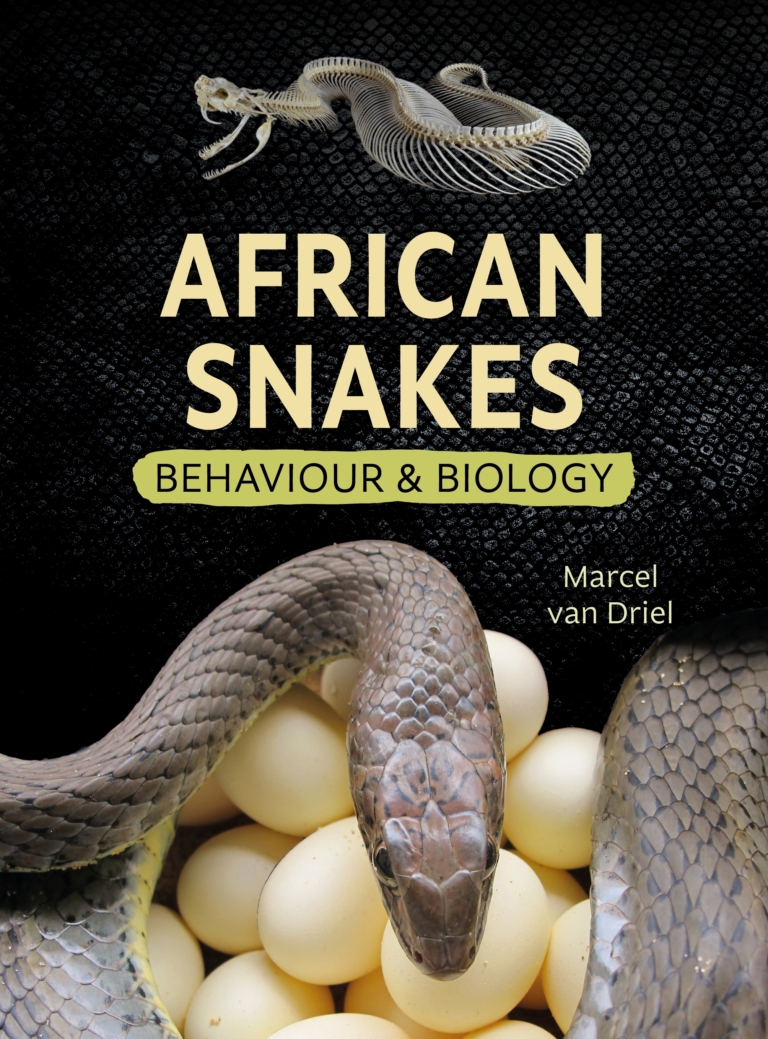
African Snakes: Behaviour and Biology
R490.00This book is also available as a paperback and eBook through Amazon UK and Amazon USA
From bush vipers to burrowing asps – snakes thrive in every habitat on the African continent. Discover how these oft-misunderstood reptiles perceive their world, defend themselves, feed and breed. This user-friendly book includes:
• The evolutionary history of snakes, with profiles of the eight families found in Africa today
• Detailed notes on inner and outer anatomy, explaining why these limbless creatures flourish in every corner of the continent
• In-depth explanations of snake behaviours, such as diverse hunting techniques and defence mechanisms
• Profiles of particularly interesting species, like the highly specialised Egg-eater and aquatic Yellow-bellied Sea Snake
• Answers to dozens of frequently asked questions: Which species is the most dangerous? How do snakes swallow prey that is larger than their head?
• Breakdown of handy diagnostic characteristics to help identify snakes in the wild -
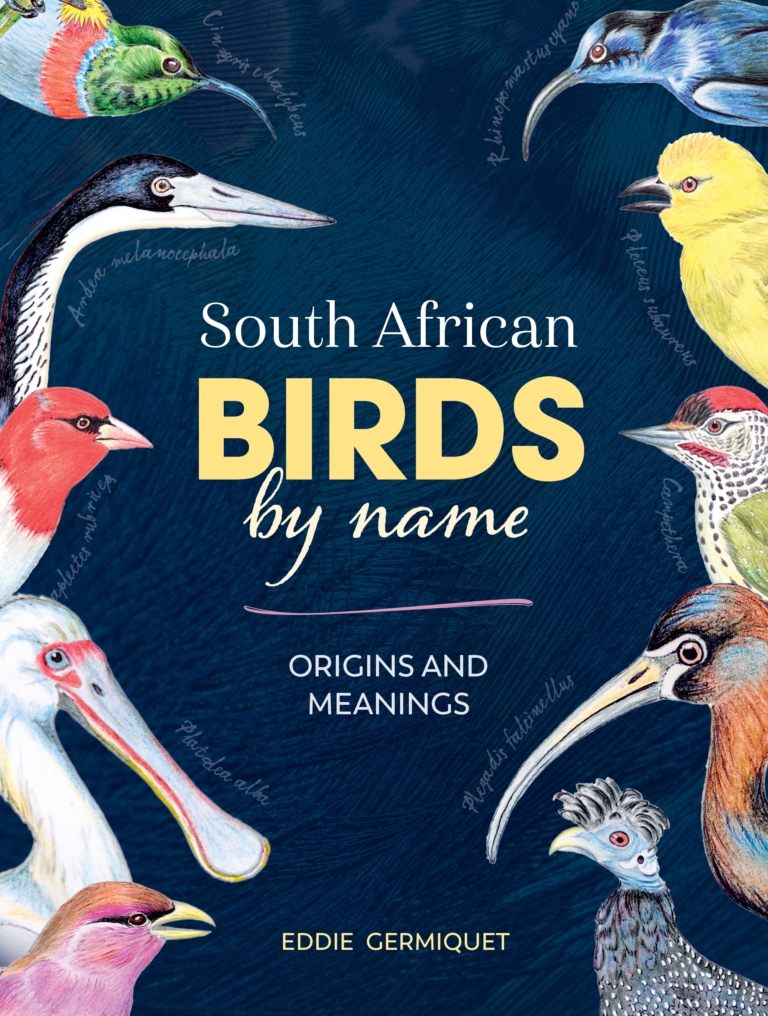
South African Birds by name – Origins and Meanings
R400.00What’s in a name? As birding grows in popularity, more and more people are beginning to appreciate that birds carry not only ecological significance but represent unique stories, embedded in the names they’ve been given. South African Birds by Name provides insight into the origins and meanings of these ‘scientific’ names, mostly rooted in Greek and Latin, helping readers to make sense of the species they are looking at.
Eddie Germiquet has paintakingly researched historic explorer accounts, indigenous names, ancient mythologies and early science writings to demystify and simplify the nomenclature. Where a name derives from a physical attribute of the bird, he has drawn a captivating illustration to depict it. Names deriving from explorers, biologists and other historical figures are also explained, uncovering some fascinating histories.
-

A Visitor’s Guide to Etosha National Park
R390.00Etosha National Park is one of Africa’s greatest wildlife sanctuaries – renowned for its stark beauty and abundant wildlife. Spanning more than 22,000 square kilometres in the semi-arid reaches of northern Namibia, it shelters a dazzling variety of mammals, birds, reptiles and other life forms, coexisting in a fragile ecosystem shaped by seasonal changes and water availability. At its heart lies Etosha Pan, the remnant of a vast inland lake, where adjacent springs and waterholes attract large herds of animals – elephants, giraffe, zebra, wildebeest, springbok, gemsbok, and the predators that follow in their wake.
While presenting a record of Etosha’s past and present, this volume also serves as a valuable guide, providing practical advice, as well as describing active waterholes and the animals that can be seen there, recommended self-drive routes for prime game viewing, and accommodation options within and beyond the park.
An indispensable companion to an unforgettable African safari.
-

The Last Lions
R750.00Lions are the stuff of legends. Revered and feared in equal measure, both majestic and terrifying, they once reigned supreme over an extensive domain. But this once-dominant beast’s original range has contracted by some 85%, and the world population is thought to have dropped to just over 20,000 individuals. The IUCN Red Data List now classifies lions as Vulnerable, and the West African subpopulation as Critically Endangered. Not only are lion numbers crashing, but the remaining populations cling to their existence on ever smaller, more fragmented pockets of land. Feared and despised by farmers trying to eke out a living on marginal land, lions are increasingly being exterminated or repurposed for commercial gain. Trophy hunters pay extortionate sums to bag specimens in their prime, and lion bones are being sold for the roaring Eastern trade in ‘tiger wine’.
This landmark book aims to halt the downward spiral. It takes you on a journey across the continent and into the lives of rangers, scientists and communities, and the majestic creatures they work to conserve. Along with the bad news about today’s lions, it offers a message of hope, showing how innovative conservationists are rethinking our approach to human-lion coexistence.
This book, with its searing, inspiring images and vivid accounts from the experts and foot-soldiers of conservation, brings the plight of lions to the attention of the world and is an urgent plea for the actions that need to be taken before it’s too late.
Addresses the alarming state of lion populations today.
-

Newman se voëls volgens kleur (NE)
R500.00Newman se Voëls volgens Kleur bied vir die beginnervoëlkyker ’n vinnige, eenvoudige manier om Suider-Afrika se algemeenste voëls volgens hul kleur te identifiseer. Die vierde uitgawe van dié nuttige geïllustreerde gids is bygewerk met die nuutste gewone voëlname, uitgebreide habitatinligting en die mees onlangse verspreidingkaarte. Die leersame inleiding bevat praktiese wenke oor die uitken van voëls, inligting oor voëlanatomie en -klassifikasie, en raad oor waar om vir voëls te soek en wat jy op só ’n uitstappie moet inpak.
-

Tracker Manual
R500.00Featuring all-new spoor drawings, some 200 new photographs, and an extra 35 species, this fully revised and updated edition of the ever-popular Tracker Manual is packed with the latest on the art of tracking. Based on information developed by some of southern Africa’s best traditional trackers, Tracker Manual gives even more guidance on how to identify the spoor of some 190 animal species. Individual chapters cover carnivores, large mammals, antelopes, small mammals, primates, hares and rodents, amphibians and reptiles, birds, and insects. Each account contains:- Simple, bulleted text on key points of each animal’s tracks
- Clear, accurate track drawings
- Numerous informative photographs, sometimes annotated
- A list of similar tracks (where applicable) to avoid misidentification.
An instructive introduction describes the science of tracking and outlines what to look for in the field, while a quick-reference table compares tracks that are easily confused. This detailed and richly illustrated manual to the region’s most common animal tracks and signs will prove invaluable in the field. -

Wildlife of Botswana: A Photographic Guide
R400.00With its mixed terrain of desert, savanna, salt pan and river delta, Botswana is home to a wide variety of wildlife, making it a prime destination for nature and wildlife enthusiasts. Wildlife of Botswana is an easy-to-use, all-in-one guide to the country’s most conspicuous and interesting mammals, birds, reptiles, invertebrates and plants.
The book includes:
- An informative introduction to the country’s geography, climate and vegetation
- Species accounts describing each species’ appearance, habits, conservation status, habitat and best viewing localities
- Full-colour photographs of each species, along with distribution maps
An excellent portable travel companion for visitors to parks, reserves and other wildlife-rich places in Botswana
-

Nature Now Snakes and other reptiles of Kruger
R290.00Besides being a world-famous game-viewing destination, the Kruger National Park also boasts a remarkable diversity of reptiles. This beginner-friendly guide features over 60 species of snake, lizard, terrapin, tortoise and crocodile, with basic identification pointers, interesting facts and notes on best viewing.
Learn more about the black mamba, puff adder, boomslang and other dangerously venomous snakes, as well as harmless creatures such as egg-eaters and blind snakes. Find out how to identify the geckos, agamas and skinks that dart around camp, and discover the habits of the Nile crocodiles and water monitors, which bask along the waterways.
A richly illustrated, beginner-friendly guide – ideal for visitors keen to identify and learn more about the park’s reptiles.
-

Hippos, a Mongoose and Me
R330.00In this sequel to the popular A Hippo Love Story, author Karen Paolillo takes us deeper into her courageous but perilous life among Africa’s wildlife.
Hippos, a Mongoose and Me is a collection of vivid stories reflecting the decades that Karen has lived and worked in the wilds of southeast Zimbabwe. The tales encompass a wide variety of animals and experiences, including Karen’s extraordinary affinity with hippos, life with her beloved mongoose, characterful baboons and rescued birds, close encounters with lions and an injured buffalo, and her heart-stopping flight from an enraged elephant. To add to the drama,
Karen and her husband Jean-Roger must face off against the drumbeat of political subterfuge and poaching of wildlife, sometimes at great personal risk.Inspiring, surprising and sometimes sad, this heartfelt anthology is testament to the courage and resilience of its intrepid author.
-

Field Guide to Insects of South Africa (NE)
R610.00This trusted best-seller has been comprehensively updated and expanded to feature accounts of over 1,500 species and insect groups. Included are the most common, most economically and ecologically important, interesting and attractive insects in the region.
It features: vivid photographs, easy-to-read text, detailed accounts covering identification, biology, distribution and related species, a helpful introduction detailing the significance, life history, collection and photography of insects, and quick reference guides on the inside covers to facilitate identification.
Entomologists both amateur and professional, students, gardeners, farmers, tourists and anyone with an interest in the natural world will appreciate this illuminating and invaluable guide.
-

Pocket Guide – Tracks & Tracking
R280.00Compact and easy to use, this book will be an invaluable tool in the wild
This handy guide provides simple tools to help interpret the tracks and signs of some 105 southern African mammals, reptiles, frogs and birds. Photographs and diagnostic spoor illustrations are given for each animal, along with information on behaviour, habits and habitat, and up-to-date distribution maps show where the animals occur.
Special features on insects and scat supplement the text and a detailed introduction offers basic guidelines for learning how to become a tracker.
-

Pocket Guide Snakes & Other Reptiles of Zambia & Malawi
R280.00Zambia and Malawi are home to 240 reptile species, of which 114 are snakes, 108 lizards, 14 terrapins and tortoises, and 2 crocodiles. Of these, 15 species occur nowhere else on Earth.
The first accessible pocket guide to the reptiles of these two tropical countries describes 186 of the most commonly encountered and colourful species, as well as those that are less conspicuous, rare and endemic to the region. A brief, informative introduction details the region’s reptile diversity and habitat types and outlines different venom types and snakebite treatments.
Handy and compact, this up-to-date guide makes a trusted travelling companion on trips to the wildlife areas, parks and reserves of these two spectacular countries.
– Succinct species descriptions cover key identification features.
– Clear full-colour photographs accompany species descriptions.
– Up-to-date distribution maps show the range of each species.
– Symbols for snake species denote the level of danger each snake’s venom poses for humans, from harmless to life-threatening. -

Field Guide to the Spiders of Southern Africa
R560.00Thoroughly revised and updated, this long-awaited new edition of Field Guide to the Spiders of South Africa remains the most comprehensive guide to South African spiders published to date. It features over 780 of the more common spider species encountered in the field and in homes and gardens, as well as representative species from some of the rarer spider families.
– ‘Quick Keys’ to the 72 South African spider families provide a useful starting point to identification.
– Succinct genus and species accounts cover identifying characteristics, breeding, behaviour, distribution and conservation status.
– Colour photographs and/or illustrations as well as distribution maps support each entry.
– Introductory chapter discusses spider morphology, spider life cycle, the functions of silk, as well as spider collection techniques.
– Section on venom identifies species that pose a danger to humans, unpacks neurotoxic and cytotoxic venom, and details the symptoms and treatment of spider bites. -

Wildlife of East Africa: Photographic Guide
R400.00This photographic guide to the wildlife of East Africa is an accessible introduction to the region’s more conspicuous and interesting mammals, birds, reptiles, frogs, insects, flowers and trees. A colour photograph accompanies each account, which describes the species’ appearance, size, and habits, and gives information on their conservation status, habitat and the best viewing localities. This book is an invaluable guide for visitors to national parks and other wildlife-rich places in East Africa and is a handy size for travel.
-

Nature Now Mammals of Kruger
R290.00This easy-to-read, fact-filled guide features over 80 mammal species found in the Kruger National Park, one of Africa’s most popular game-viewing destinations.
Packed with stunning photographs and engaging text, it provides brief pointers for accurate identification and highlights the most interesting facts about each species. Did you know that leopards are more dangerous than lions, elephants use their trunks to snorkel, giraffes give birth standing up, and no two zebras have the same stripe pattern?Aimed at nature enthusiasts of all ages, this compact guide:
– Covers the Park’s rich diversity of mammals – from the world-famous Big Five to the miniature mongooses seen dashing across the road
– Unpacks each animal’s most interesting characteristics and behaviours
– Notes the record-breakers: who has the longest horns, strongest jaws or greatest appetite?
– Provides game-watching tips for successful safaris, as well as ‘Best viewing’ notes for each species
– Features striking photographs of Kruger’s wildlife in action -

A Complete Guide to the Snakes of Southern Africa
R580.00This long-awaited third edition of A Complete Guide to the Snakes of Southern Africa has been updated, revised and expanded. New information based on scientific research relating to behaviour, identification, reproduction and snake venoms has been included in the species accounts. Features of this book:
– Covers all essential aspects of snake biology and behaviour.
– Species descriptions are accompanied by full-colour photographs and distribution maps.
– Simple icons make essential information available at a glance.
– A separate ‘key features’ box assists in quickly identifying species in the field.
– Chapters on classification and identification, keeping snakes, and the treatment of snakebite supplement the species accounts. -

‘n Volledige gids tot die slange van Suider-afrika
R580.00Hierdie langverwagte derde uitgawe van ‘n Volledige Gids tot die Slange van Suider-Afrika is ten volle opgedateer. Nuwe inligting gebasseer op wetenskaplike navorsing is ingesluit, en hou verband met gedrag, identifikasie, voortplanting en gif. Kenmerke van hierdie boek:
– Dek al die noodsaaklike aspekte van biologie en slang gedrag.
– Spesies se beskrywings word vergesel van volkleur fotos en verspreidingskaarte.
– Eenvoudige simbole maak belangrike inligting dadelik beskikbaar.
– ‘n Aparte ‘Kyk uit vir’ blokkie help om spesies in die veld gou te identifiseer.
– Hoofstukke oor klassifikasie en identifikasie, aanhou van slange, en die behandeling van slangbyte vul die inligting aan. -

Stuarts’ Field Guide to National Parks and Game Reserves – Namibia, Botswana, Zimbabwe, Zambia and Malawi
R450.00The first guide ever to document and explore the diverse parks and reserves of Africa’s ‘middle belt’, it covers Namibia, Botswana, Zimbabwe, Zambia and Malawi. The region contains prized spots such as the world-famous landscapes of the Namib and Kalahari deserts, Okavango Delta, Victoria Falls and Lake Malawi, and some of Africa’s best-known conservation areas, including Etosha, Chobe, Mana Pools, Hwange, Kafue and Nyika.
-

The Living Deserts of Southern Africa
R600.00For generations, the deserts of southern Africa have intrigued scientists and travellers alike. Seemingly barren wastes, they in fact teem with life – from ants to elephants, stone plants to the curious welwitschia, dainty dik-diks to towering gemsbok, and cart-wheeling spiders to fog-basking beetles. How do they cope with scarce resources, unpredictable rainfall and extreme temperatures? How do they protect themselves against predators? And what is the impact of climate change on these life forms and their habitats?
Drawing on an earlier edition, published in 1993, biologist Barry Lovegrove answers these questions and unravels many of the mysteries associated with life in the desert. He describes the four arid biomes of South Africa, Namibia and Botswana –
Desert, Arid Savanna, Succulent Karoo and Nama-Karoo – and explains how and why such a great diversity of plants, insects, mammals, reptiles and birds successfully exist in these regions. The text is supported by the most recent research, spectacular photographs, and explanatory diagrams and maps.The Living Deserts of Southern Africa is a compelling, in-depth read that is accessible to both the serious student and academic as well as the interested nature lover.
-

Shaping Addo: The Story of a Southern African National Park
R440.00More than a century ago elephants in the eastern Cape were systematically hunted – until only 16 were left . Today there are 650 elephants in the Addo Elephant National Park, the densest concentration of wild elephants anywhere on the planet. While elephants are undoubtedly still the park’s top drawcard, the past four decades have seen the emphasis shift from protecting a single species to conserving five biomes and the wild animals that occupy them. Today, Addo can boast the Big Seven: elephant, lion, leopard, buffalo, rhino, as well as great white shark and southern right whale.
Like Shaping Kruger, its successful predecessor, Shaping Addo expertly delves into the history of the park, detailing the positive impact that changing conservation practices have had on its development. Drawing on decades of groundbreaking research, the author provides fascinating insight into the lives and habits of the animals (both terrestrial and marine), examining individual species, the relationship between them, and the carefully crafted management strategies required to ensure the survival of all species.
Shaping Addo is an engrossing account of how a seemingly insigni cant sanctuary was transformed into an astonishingly successful mega-park, and the most ecologically diverse protected space in South Africa.
-

Pangolins: Scales of Injustice
R230.00Smuggled into China and sold for meat in the live-animal markets of cities such as Wuhan, the pangolin has dominated world headlines. Is it the vector for Covid-19?
Pangolins have long been sustainably harvested by local communities for their meat and scales, but today the burgeoning trade in these mammals has reached crisis point. Eight pangolin species occur worldwide, four in Asia and four in Africa, and all face extinction if current rates of hunting and trading continue unabated.
Now the spotlight is on the world’s most trafficked mammal. Scientists have identified pangolins as the likely source of the coronavirus infection that has brought the world to its knees. This multi-trillion dollar disaster makes pangolins the most expensive meals ever eaten.
In this timely expose, Richard Peirce unpacks the horrors and dangers of the trade in this enigmatic, little-known mammal. He explains the links between wildlife and Covid-19, and details China’s response to the pandemic.
He also tells the story of a particular pangolin poached in Zimbabwe and brought to South Africa to be traded. Readers accompany an agent of the African Pangolin Working Group, assisted by the local police, on an actual sting operation to rescue the animal and capture the traffickers. And they follow the subsequent progress of the rescued pangolin, from near death to rehabilitation and release into the wild.
-

Skullduggery – Quick ID Guide
R100.00In this short but informative guide, trusted authors Chris and Mathilde Stuart turn mammal ID on its head – literally. The identification of mammal skulls is the subject of this latest addition to the quirky ‘Quick Guide’ series, and covers the most common skulls readers are likely to encounter in the wild – from easily recognisable species such as elephant, hippo, rhino, baboons, antelope, whales and dolphins, to the more challenging family groups: dogs, cats, hyaenas, equids, pigs, civets and genets, mongooses, rats and mice, bats, sengis, shrews, moles, hares and rabbits, hyrax, and squirrels.
Each entry features:
Close-up photographs showing the entire skull, teeth and, where available, upper and lower jaws
Pointers to diagnostic features
Average measurement for skull length
Short description highlighting main features of each skull and tooth structure
Dental formula for teeth in upper and lower jaws
A brief introduction, with labelled photographs, covers anatomy as well as dentition; and a quick-reference photographic key to the main animal groups appears on the inside front cover.An ideal companion to mammal field guides, this book will be appeal to rangers, safari guides and all nature lovers wanting to deepen their understanding of life in the bush.
-

Avian Architects Quick ID Guide
R100.00Another title in the ‘Quick Guide’ series, this compact little book is a handy identification guide to the surprising variety of nests built by southern African birds. Covering multiple species, it is arranged according to nest type – ground, woven, stick, cup, mud-pellet and domed, as well as nests in tree holes, on water, on cliffs and in scrapes on the ground. It is packed with photographs and illustrations showing the ingenuity of the designs, the birds that built them, and the eggs that are laid in them. In pithy fashion, the text – matched to the photographs – describes:
nesting site and nest structure
building materials used to construct outer and inner layers
nesting habits of the architects
clutch sizeA simple key to nest types on the inside front cover directs readers to the relevant section in the book.
-

Wildlife of Namibia: A Photographic Guide
R400.00Namibia is a fascinating land of contrasts, where floodplains, swamps and the world’s oldest desert have contributed to a rich biodiversity. Wildlife of Namibia is an easy-to-use guide to the country’s most conspicuous and interesting mammals, birds, reptiles, invertebrates and plants.
The book includes:
- An informative introduction to the country’s geography, climate and vegetation
- Accounts describing each species’ appearance, habits, size and conservation status, as well as information on habitat and best viewing localities
- Full-colour photographs of each species, along with distribution maps to show their range
- This all-in-one compact guide will prove invaluable to visitors to national parks, nature reserves and other wildlife-rich places in Namibia.
-

Wildlife of Namibia (German): A Photographic Guide
R400.00Namibia is a fascinating land of contrasts, where floodplains, swamps and the world’s oldest desert have contributed to a rich biodiversity. Wildlife of Namibia is an easy-to-use guide to the country’s most conspicuous and interesting mammals, birds, reptiles, invertebrates and plants.
The book includes:
An informative introduction to the country’s geography, climate and vegetation
Accounts describing each species’ appearance, habits, size and conservation status, as well as information on habitat and best viewing localities
Full-colour photographs of each species, along with distribution maps to show their rangeThis all-in-one compact guide will prove invaluable to visitors to national parks, nature reserves and other wildlife-rich places in Namibia.
-

Guide to Dragonflies & Damselflies of South Africa (NE)
R500.00In this fully revised edition of A Guide to Dragonflies & Damselflies of South Africa, all 164 species known to occur in South Africa, Lesotho and Swaziland are described and illustrated, grouped according to family (six dragonfly and six damselfly families). The species entries feature scans of live insects (close-up and side-view images) and photographs of specimens in their natural environment and showing key behaviours. Detailed descriptions focus on size, identifying features and occurrence. An introductory chapter unpacks the life cycle, behaviour, biology and breeding of this fascinating group of insects. Presented in a classic field guide format, this revised edition now also features:
Expanded annotations to all illustrations, highlighting diagnostic features to ensure accurate identification
New distribution maps
Additional colour plates and photographsBeautifully presented, informative and authoritative, this book will appeal to anyone with an interest in South Africa’s insect life, and to nature lovers in general.
-

Field Guide to Tracks & Signs – East Africa NE
R590.00Originally published in 1994, A Field Guide to Tracks and Signs of Southern and East African Wildlife quickly became the standard reference to the subject in the region, reprinting many times. This new edition provides the most detailed coverage of tracks, droppings, bird pellets, nests and shelters and feeding signs, not only for mammals, but also for birds, reptiles, insects and other invertebrates. Greatly expanded, this extensive update now features: full colour throughout.
-

Scorpions of Southern Africa (NE)
R320.00Scorpions of Southern Africa, the go-to guide for identifying southern Africa’s rich scorpion fauna, has now been freshly designed, updated and expanded. It includes 12 additional species, new images and distribution maps, and a chapter on how to go about identifying scorpions.
An invaluable guide for the amateur naturalist and professional alike, this accessible book describes:
- scorpion anatomy and behaviour,
- the strategies that enable scorpions to survive harsh conditions,
- their use of venom, and
- other aspects of their successful existence over millions of years.
-

Wild Karoo
R280.00After centuries of relative isolation, the Karoo – South Africa’s parched heartland – is a latecomer to the tourist industry. What was once viewed as a harsh and desolate place of limited attraction is rapidly gaining popularity with visitors who now make the Karoo their destination, keen to partake of its legendary charm, its extraordinary flora and the resurgence of wildlife that once again populates its plains.
Wild Karoo documents Mitch Reardon’s 4,000-kilometre journey of discovery through the region. The book focuses on:
local nature conservation in all its facets
the game, large and small – some recently reintroduced – plus birds, reptiles and invertebrates
the unique, arid-adapted flora
the landscape and geology
the history and lifestyle of the people who have made a home here
plans to combine public and private protected land to create wildlife corridors between isolated parks, re-establishing old migration routes and so reversing some of the effects of human settlementBeautifully written, and illustrated with evocative photographs, this book is a must read for anyone interested in travel, wildlife and the environment.
-

Cuddle Me, Kill Me
R230.00Canned lion hunting sprang to the world’s attention with the 2015 launch of the documentary, Blood Lions. This movie blew the cover off a brutal industry that has burgeoned in the last decade or so, operating largely under the radar of public concern.In Cuddle Me Kill Me, veteran wildlife campaigner Richard Peirce reveals horrifying facts about the industry. He tells- The true story of two male lions rescued from breeding farms
- The exploitation and misery of these apex predators when they are bred in captivity
- How young cubs are removed from their mothers mere hours after birth
- How they are first used for petting by an adoring (and paying) public
- Their subsequent use for ‘walking with lions’ tourism
- And how, in the final stage of exploitation, they are served up in fenced enclosure for execution by canned hunters – or simply shot by breeders for the value of their carcass, a prized product in the East.
Well researched by Peirce with the help of an undercover agent, and illustrated with photos taken along the way, this is a disturbing and passionate plea to end commercial captive lion breeding and the re-purposing of wildlife to cater for human greed. -

Stuarts’ Field Guide to the Larger Mammals of Africa
R610.00Of the more than 5,500 mammals species worldwide, at least 1,200 occur in Africa. Stuarts’ Field Guide to the Larger Mammals of Africa concentrates on the more visible and easily distinguished larger species, as well as some of the more frequently seen smaller mammals.This new edition has been extensively revised, expanded and redesigned and includes:- the most recent research and taxonomy
- revised distribution maps and many new images
- colour-coded grouping of orders
- size icons
- detailed descriptions of each species, offering insight into key identification characters, typical behaviour, preferred habitat, food choice, reproduction and longevity
- whales and dolphins now featured too
-

Understanding Elephants
R210.00Elephants are arguably Africa’s most charismatic animals, and among the biggest drawcards to our game reserves. While the burgeoning game-park industry may be increasing our access to these magnificent creatures, rising human-elephant encounters are an inevitable outcome – sometimes, sadly, fatal. Such encounters could likely have been avoided had those involved understood elephant behaviour, and particularly how these intelligent animals interface with traffic through their territory. This book describes elephant family life, from rearing of infants to establishing dominance within a herd; it unpacks regular elephant behaviour, the matriarchal system, the particular dangers of males in musth, and many other aspects of their lives. Most of all, it provides guidelines for ensuring safe and enjoyable encounters with these majestic animals. This is an essential guide for those planning visits to reserves: aside from the interest factor, being able to read the tell-tale signs may just save lives.
-

Eerste veldgids: Natuurlewe van Suider-Afrika
R130.00Hierdie gids is deel van ‘n nuwe reeks, Eerste veldgidse, en bied ‘n fassinerende blik op die natuurlewe van die streek.
Met behulp van kleurfoto’s en -verspreidingskaarte asook maklik leesbare teks, sal die beginner- en ontluikende natuurkenner die meer algemene diere van Suider-Afrika kan identifiseer, kan vasstel waar hulle voorkom, en meer te wete kom oor hul unieke gedrag en ongewone eienskappe.
-

Natuurlewe van Suider-Afrika
R470.00Hierdie gewilde veldgids tot die natuurlewe van Suider-Afrika, jare lank al ’n vertroude metgesel van natuurliefhebbers, is nou omvattend bygewerk. Dit bied beskrywings en akkurate illustrasies in volle kleur van meer as 2,000 plante en diere asook verspreidingskaarte vir die meeste groepe. Elke hoofstuk het sy eie kleurkode om naslaan te vergemaklik en uitkenmerke in die beskrywings is in vetdruk. Elke hoofstuk is geskryf deur ’n kenner op sy gebied.
Al die vernaamste plant- en diergroepe is ingesluit:
- Laer ongewerweldes
- Spinnekoppe en ander spinagtiges
- Insekte
- Varswatervisse
- Paddas
- Reptiele
- Voëls
- Soogdiere
- Grasse, biesies, varings en swamme
- Veldblomme
- Bome
-

Wildlife of Southern Africa
R470.00This long-standing, trusted field guide to the wildlife of southern Africa has been comprehensively updated and now includes distribution maps. It describes over 2,000 plants and animals, each accompanied by accurate illustrations in full colour. This book has been a trusted field companion for many years. Comprehensively updated, it now features range maps for most groups. The chapters are colour-coded for easy reference, and diagnostic features appear in bold type within the descriptions. Each chapter is written by a leading expert in the field.
All the main plant and animal groups are covered:
- Lower invertebrates
- Spiders and other arachnids
- Insects
- Freshwater fishes
- Frogs
- Reptiles
- Birds
- Mammals
- Grasses, hedges, ferns and fungi
- Wild flowers
- Trees


