


Also available in e-book format:

Amazon Kindle

Google Books

Snapplify Reader
Wild Flowers: Kenya & North Tanzania
TAKE A CLOSER LOOK
| Author: | Anne Powys |
|---|
R350.00
A compact guide featuring nearly 400 wild flowers of Kenya and northern Tanzania, grouped for ease of use according to colour. The book includes the most widespread and commonly encountered species as well as some unusual flowers found in more remote areas.
Plants range from hardy succulents to spectacular epiphytic orchids and shaggy mountain lobelias, each concisely presented with reference to key features and typical habitat. Additional notes indicate whether a given species has particular ecological, medicinal or cultural value.
In stock
Customer Reviews
There are no reviews yet.
Related products
-

Frogs of Southern Africa: A Complete Guide
R690.00Frogs of Southern Africa: A Complete Guide remains the most authoritative and comprehensive treatment of the frogs of the region ever produced, covering all aspects of frog and tadpole biology and behaviour.
This new edition (with a slight name change) has been thoroughly updated to reflect taxonomic changes based on the most recent research and DNA studies, and includes 12 new species and more than 130 new images. All 169 southern African frog species, and their tadpole stages, are fully described, along with their conservation status, calls, habitat and habits. Identification is made easy with the aid of over 1000 large, full-colour images, keys to species and summary panels on ‘Key ID points’ and ‘Distinctive characters’.
Calls for most species can be accessed instantly via QR codes in the book or downloaded from a dedicated website. Spectrograms of the calls are also included in the book.
Written by respected authorities in the field, this timely updated edition will be of benefit to all nature lovers, amateur ‘froggers’, students and professional scientists.
-

Guide to Dragonflies & Damselflies of South Africa (NE)
R500.00In this fully revised edition of A Guide to Dragonflies & Damselflies of South Africa, all 164 species known to occur in South Africa, Lesotho and Swaziland are described and illustrated, grouped according to family (six dragonfly and six damselfly families). The species entries feature scans of live insects (close-up and side-view images) and photographs of specimens in their natural environment and showing key behaviours. Detailed descriptions focus on size, identifying features and occurrence. An introductory chapter unpacks the life cycle, behaviour, biology and breeding of this fascinating group of insects. Presented in a classic field guide format, this revised edition now also features:
Expanded annotations to all illustrations, highlighting diagnostic features to ensure accurate identification
New distribution maps
Additional colour plates and photographsBeautifully presented, informative and authoritative, this book will appeal to anyone with an interest in South Africa’s insect life, and to nature lovers in general.
-

Field Guide to Scorpions of South Africa
R480.00An authoritative antidote to the myths surrounding these often maligned and misunderstood creatures.
Among the world’s most fascinating living fossils, scorpions have been around for some 420 million years. South Africa is home to an astonishing variety, with 108 species in three families occurring in most of the region’s biomes, from desert and grassland to fynbos, savanna and forest. Scorpions are even found in urban gardens.
Field Guide to Scorpions of South Africa is the first comprehensive guide to describe and illustrate all known species in the country. The clear, detailed species accounts cover appearance, habitat and behaviour, and discuss the variation within species according to region. Up-to-date distribution maps are included for all species and exceptional photographs, carefully worked to show astounding detail and vivid colours, bring to life the intricate patterning and colours of different species. Both males and females are presented, as well as a variety of colour forms, facilitating accurate identification in the field.
The introduction discusses scorpion classification, anatomy, biology, behaviour and habitat, as well as venomosity and the treatment of stings. Tips on how and where to find scorpions and how to contribute to their conservation as a citizen scientist are also included.
An invaluable tool for students, researchers, academics, hikers and anyone with an interest in South Africa’s rich and fascinating fauna.
-

Field Guide to the Amaryllis Family of Southern Africa and Surrounding Territories
R500.00The Amaryllidaceae family is distributed in warm temperate and tropical parts of the world. With 18 genera and 265 taxa occurring in the region, southern Africa is recognised as a major centre of diversity for this intriguing family. This compelling guide features all the species found in the region, conveniently grouped according to the biome of their natural habitat, and includes a useful key to genera and species.
Species accounts feature:
– Comprehensive text suitable for laypersons and scientists
– Information on distribution, similar taxons, life cycle and flowering period
– Notes on cultivation, history, medicinal properties and conservation
– Distribution maps
– Colour photographs and watercolour platesAn invaluable addition to the library of any plant or nature lover.
-
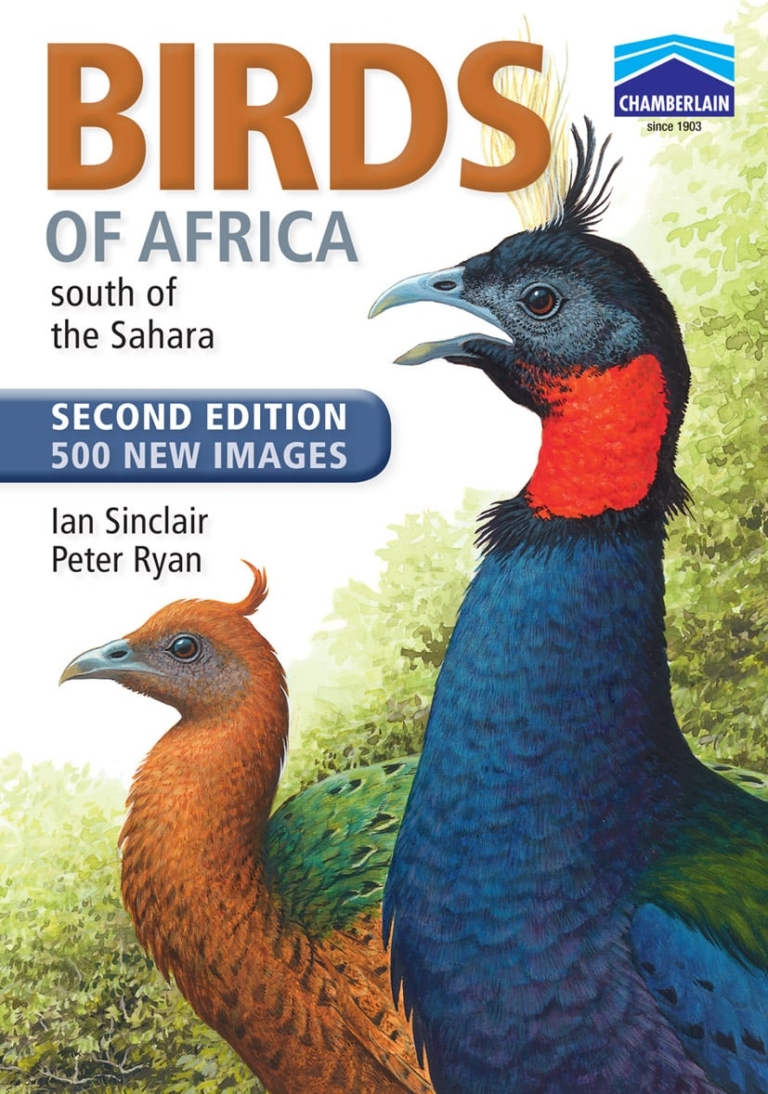
Chamberlain’s Field Guides Birds of Southern Africa
R680.00Fully revised, Birds of Africa south of the Sahara provides unrivalled coverage of African birds in a single volume, and is the first book to describe and illustrate all of the birds found in Africa south of the Sahara Desert (the Afrotropic Region), including Socotra, Pemba and islands in the Gulf of Guinea. Over 2 500 colour photographs show age and sex plumage variations, perched and in-flight birds, and colour morphs where relevant. Text – by Africa’s top birding authors – forcuses on identification, call, habitat and status, breeding details and diet. Colour-coded distribution maps show resident and migratory status and bird density. Annual calendar bars indicate, at a glace, w hen species are present and when they breed. Despite its exceptional coverage, this guide is compact enough to use in the field, and follows the standard field guide format, with texts and range maps appearing opposite the colour plates.
-

Field Guide to Succulents of Southern Africa
R450.00Southern Africa is the natural home of the richest and most diverse succulent flora in the world. These plants come in all shapes and sizes, from trees such as the baobab at more than 20 m tall, to miniature soil huggers, just a few millimetres high, which mimic their pebble-desert surroundings. This user-friendly, richly illustrated field guide features more than 700 southern African succulents, focusing on the most interesting and commonly encountered species. An introduction to families and their key features will help readers identify the relevant plant group, while concise accounts describing the plants’ diagnostic features, along with distribution maps, will enable quick ID of species. More than just an ID guide for plant lovers, this book will inspire gardeners who are turning to indigenous, low-maintenance and water-wise plants for cultivation.
-

Field Guide to Trees & Shrubs of East Africa
R610.00Fully updated and expanded, this third edition of the top-selling Field Guide to Common Trees & Shrubs of East Africa now features more than 520 of the trees and shrubs – indigenous and naturalized exotics – commonly found in the region.
Each of the four sections – trees, shrubs, palms and mangroves – is arranged in alphabetical order according to scientific name. The book features:
An informative introduction to families.
Species accounts describing the plants’ habitat, bark, leaves, flowers and fruit.
General and commercial applications and uses in traditional medicine.
Almost 2,000 photographs depicting the species, its fruit, flowers and bark.
Glossaries, both textual and illustrated, of botanical and medical terms. -

Field Guide to Fynbos
R610.00Field Guide to Fynbos features over 1,000 species from the Cape Floristic Region – home to one of the world’s richest floras. This fully updated edition focuses on the most common and ‘showy’ plants.
An introduction unpacks the world of fynbos – including origins, diversity, climate and adaptations – and is followed by a photographic key and descriptions of the fynbos families. Species descriptions are accompanied by photographs, distribution maps, comparisons with similar species, and notes on traditional uses.
For botanists and amateurs alike, this will remain an indispensable guide to South Africa’s most renowned flora.
Be the first to review “Wild Flowers: Kenya & North Tanzania”
You must be logged in to post a review.