

Also available in e-book format:

Amazon Kindle

Google Books

Snapplify Reader
Weefselsoute vir Heilsaamheid
| Author: | Margaret Roberts |
|---|
R270.00
Hierdie boek is waarskynlik een van die mees ongewone wat jy ooit sal lees – een wat jou denke oor gesondheid en jou hantering van stres in die daaglikse lewe sal verander. Weefselsoute – ook bekend as sel- of biochemiese soute – is ’n groep van 12 minerale wat perfek gebalanseerd in ons liggame teenwoordig behoort te wees sodat ons heeltemal gesond kan wees. Dié soute word in die natuur in die aarde se gesteentes en grond aangetref en kom natuurlik voor in gewasse wat organies in mineraalryke grond gekweek is.
In stock
Customer Reviews
There are no reviews yet.
Related products
-

Plants of the Baviaanskloof
R560.00Tucked away in the southwestern corner of the Eastern Cape lies a narrow valley, flanked by the Baviaanskloof and Kouga mountain ranges. Named after the chacma baboons that long ago made this 200-km-long kloof their home, the Baviaanskloof is part of the Cape Floral Region World Heritage Site. It is a meeting point of several different ecosystems, with almost all of South Africa’s eight biomes represented, making for an exceptional diversity of species, including many endemics.
Plants of the Baviaanskloof describes well over 1,000 plant species. It includes:
– Succinct descriptions of each plant species with full-colour photographs
– Brief family and genus descriptions, and species counts for the area
– An introduction covering the geology, climate and vegetation types of the regionCompiled over two decades, Plants of the Baviaanskloof is sure to become an enduring record of the diversity of plant life found here. The only botanical guide for this area, it is a must-have for botanists, gardeners, road-trippers, hikers, travellers and all who have a deep interest in plants.
-

Nature Now Insects and Other Critters of Kruger
R290.00Besides being a world-famous game-viewing destination, the Kruger National Park is
home to an incredible diversity of bugs, beetles, butterflies, spiders, scorpions and other creepy-crawlies. Packed with colour photographs, this visual guide will appeal to anyone keen to identify and learn more about the Park’s infinite variety of smaller inhabitants. Find out what
happens inside a termite mound, how ladybirds protect themselves from predators, and why dung beetles race to fresh dung pats. This handy book:– Spans 30 groups, including moths, beetles, wasps, crickets and spiders, and features over 200 commonly encountered species
– Contains vivid photographs of Kruger’s most interesting and attractive critters
– Unpacks noteworthy behaviours and biology
– Introduces key concepts, such as mimicry, cryptic coloration, metamorphosis, parasitism and pollination
– Includes bug-watching and photography tips for beginners -

Tissue Salts for Healthy Living
R270.00Tissue Salts are a group of 12 minerals that should be present in our bodies to ensure good health and well-being. These salts are found naturally in the earth’s rocks and soil, and are present in food grown organically in mineral-rich soils.
-

Kids’ Spiders of Southern Africa
R200.00Welcome to the weird and wonderful world of southern African spiders – they come in all shapes and sizes, and are more colourful and clever than you think!
This jam-packed children’s book unpacks where spiders live, what they eat, how they hunt, what venom they have and how they protect their babies. Striking macrophotography showcases the world of spiders like never before. Meet a spider that spits sticky silk, one that hides in seashells, another that pretends to be an ant . . . and over fifty more – from the familiar Daddy Long Legs to exotic-looking Flower Crab Spiders, spiky Hedgehog Spiders and well-camouflaged Bark Spiders.
-

Pocket Guide – Tracks & Tracking
R280.00Compact and easy to use, this book will be an invaluable tool in the wild
This handy guide provides simple tools to help interpret the tracks and signs of some 105 southern African mammals, reptiles, frogs and birds. Photographs and diagnostic spoor illustrations are given for each animal, along with information on behaviour, habits and habitat, and up-to-date distribution maps show where the animals occur.
Special features on insects and scat supplement the text and a detailed introduction offers basic guidelines for learning how to become a tracker.
-

Field Guide to the Spiders of Southern Africa
R560.00Thoroughly revised and updated, this long-awaited new edition of Field Guide to the Spiders of South Africa remains the most comprehensive guide to South African spiders published to date. It features over 780 of the more common spider species encountered in the field and in homes and gardens, as well as representative species from some of the rarer spider families.
– ‘Quick Keys’ to the 72 South African spider families provide a useful starting point to identification.
– Succinct genus and species accounts cover identifying characteristics, breeding, behaviour, distribution and conservation status.
– Colour photographs and/or illustrations as well as distribution maps support each entry.
– Introductory chapter discusses spider morphology, spider life cycle, the functions of silk, as well as spider collection techniques.
– Section on venom identifies species that pose a danger to humans, unpacks neurotoxic and cytotoxic venom, and details the symptoms and treatment of spider bites. -

Pocket Guide Snakes & Other Reptiles of Zambia & Malawi
R280.00Zambia and Malawi are home to 240 reptile species, of which 114 are snakes, 108 lizards, 14 terrapins and tortoises, and 2 crocodiles. Of these, 15 species occur nowhere else on Earth.
The first accessible pocket guide to the reptiles of these two tropical countries describes 186 of the most commonly encountered and colourful species, as well as those that are less conspicuous, rare and endemic to the region. A brief, informative introduction details the region’s reptile diversity and habitat types and outlines different venom types and snakebite treatments.
Handy and compact, this up-to-date guide makes a trusted travelling companion on trips to the wildlife areas, parks and reserves of these two spectacular countries.
– Succinct species descriptions cover key identification features.
– Clear full-colour photographs accompany species descriptions.
– Up-to-date distribution maps show the range of each species.
– Symbols for snake species denote the level of danger each snake’s venom poses for humans, from harmless to life-threatening. -
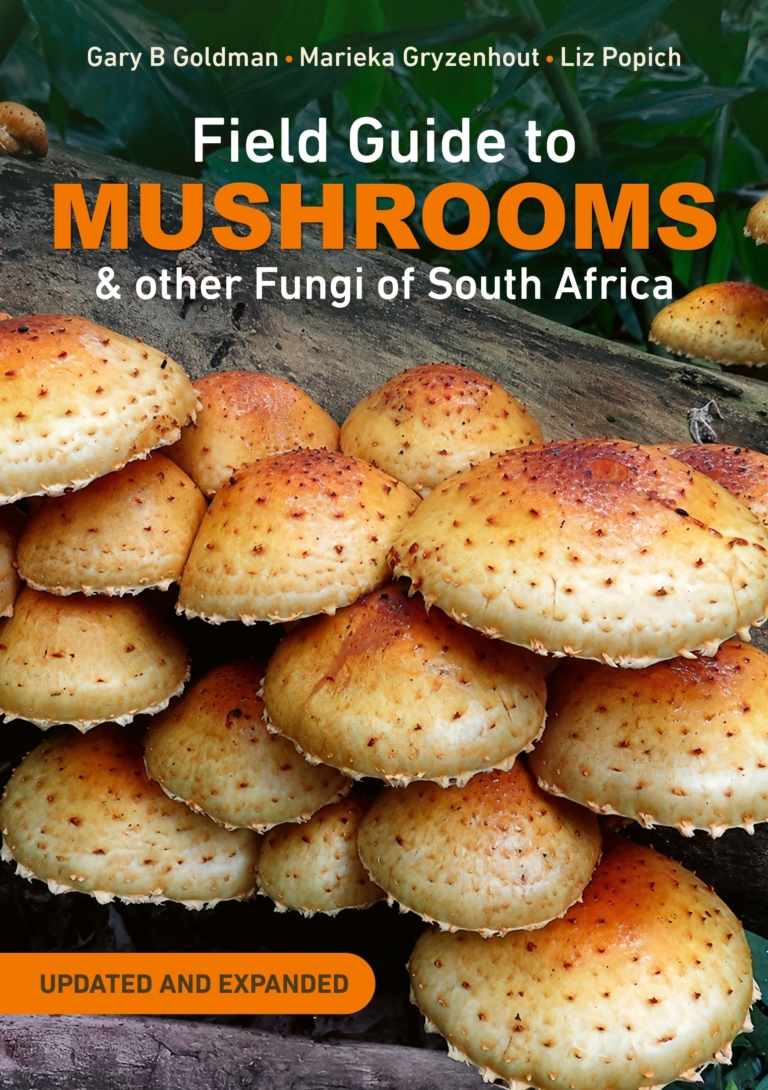
Field Guide Mushrooms and other Fungi of South Africa (New Ed)
R620.00Building on the success of the original book, this new edition of the Field Guide to Mushrooms & other Fungi of South Africa now covers 420 species – more than any mushroom book in the region. The revised edition has been fully updated and expanded, with 220 new entries added and more than 1,000 new photographs.
Neither plant nor animal, mushrooms constitute a unique group of organisms. They appear in a staggering variety of shapes, sizes and colours, and identifying them can be difficult. Featuring the most distinctive and commonly found species in South Africa, this guide is the perfect tool for quick and accurate identification in the field. The text for each species covers diagnostic features, distribution (both regionally and worldwide), typical habitat, edibility and toxicity. Magnificent photographs accompany each description, making this both a practical guide and a beautiful book.
A brief introduction outlines the basic anatomy and biology of mushrooms, their use for humans, and the vital role they play in sustaining all life. Guidelines for foraging and photographing mushrooms are also included. Packed with information, this guide will be welcomed by all mushroom enthusiasts, and by nature lovers in general.
Be the first to review “Weefselsoute vir Heilsaamheid”
You must be logged in to post a review.