

Also available in e-book format:

Amazon Kindle

Google Books

Snapplify Reader
Grasses of East Africa
TAKE A CLOSER LOOK
| Author: | Dino J. Martins |
|---|
R400.00
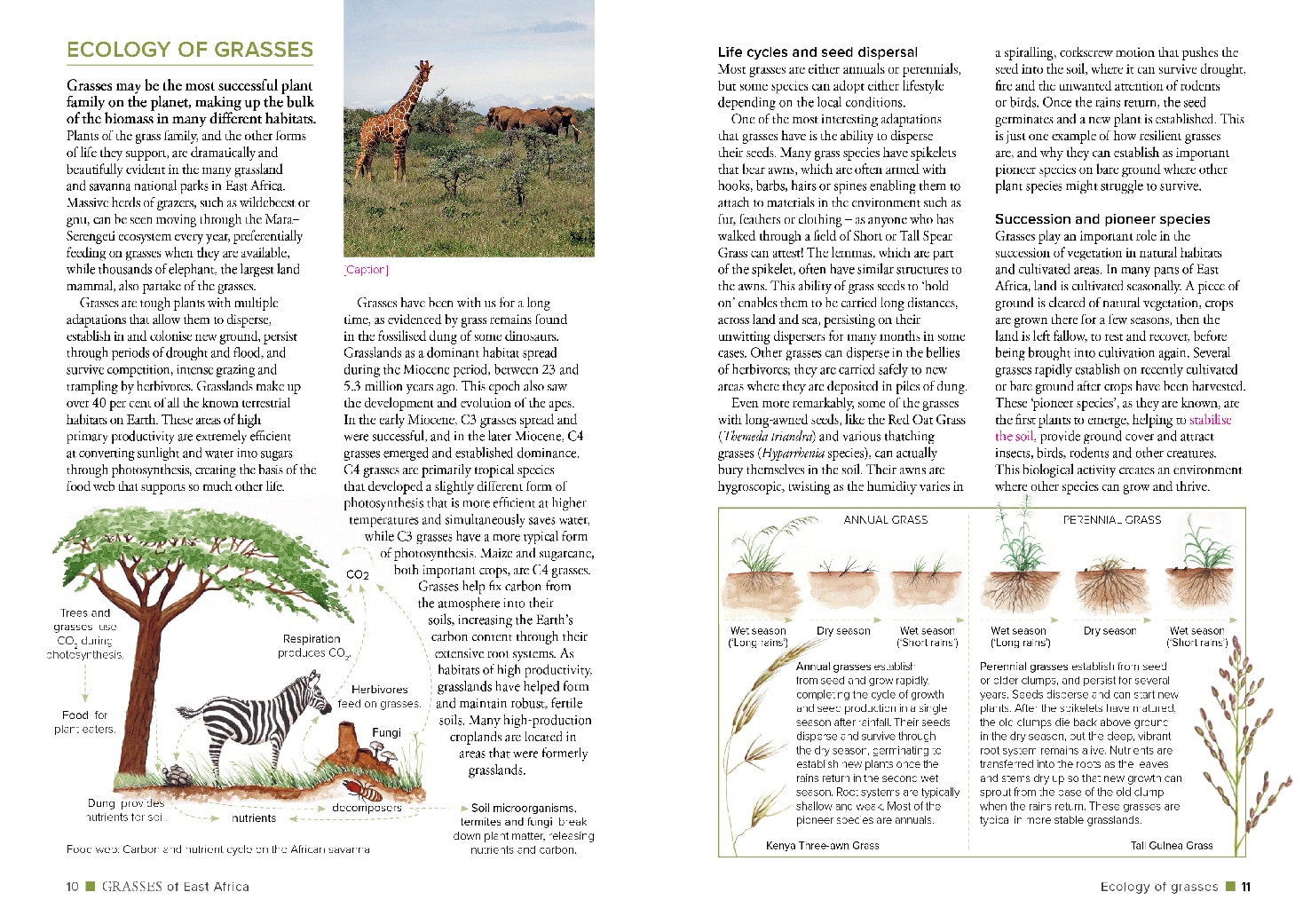
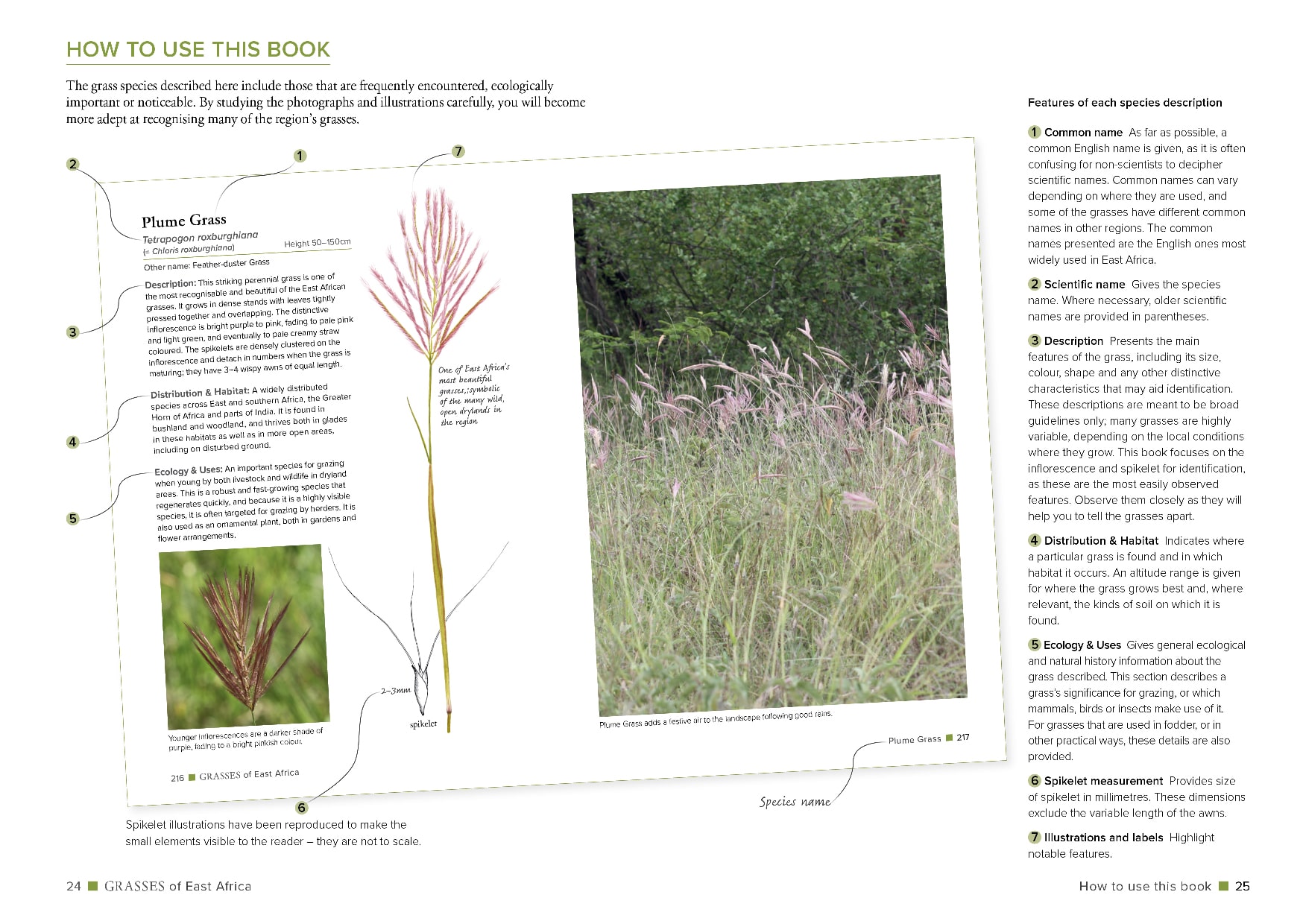
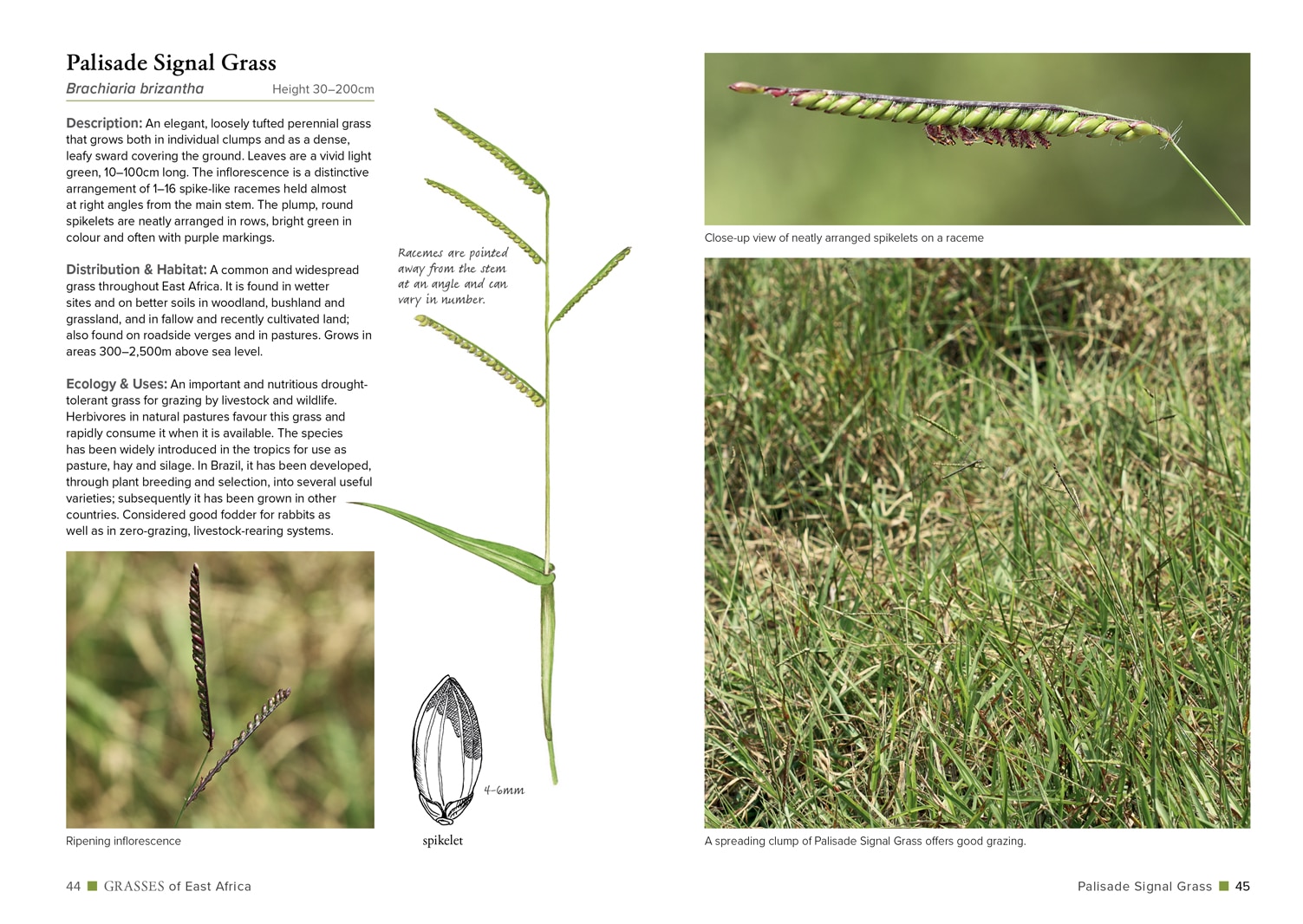
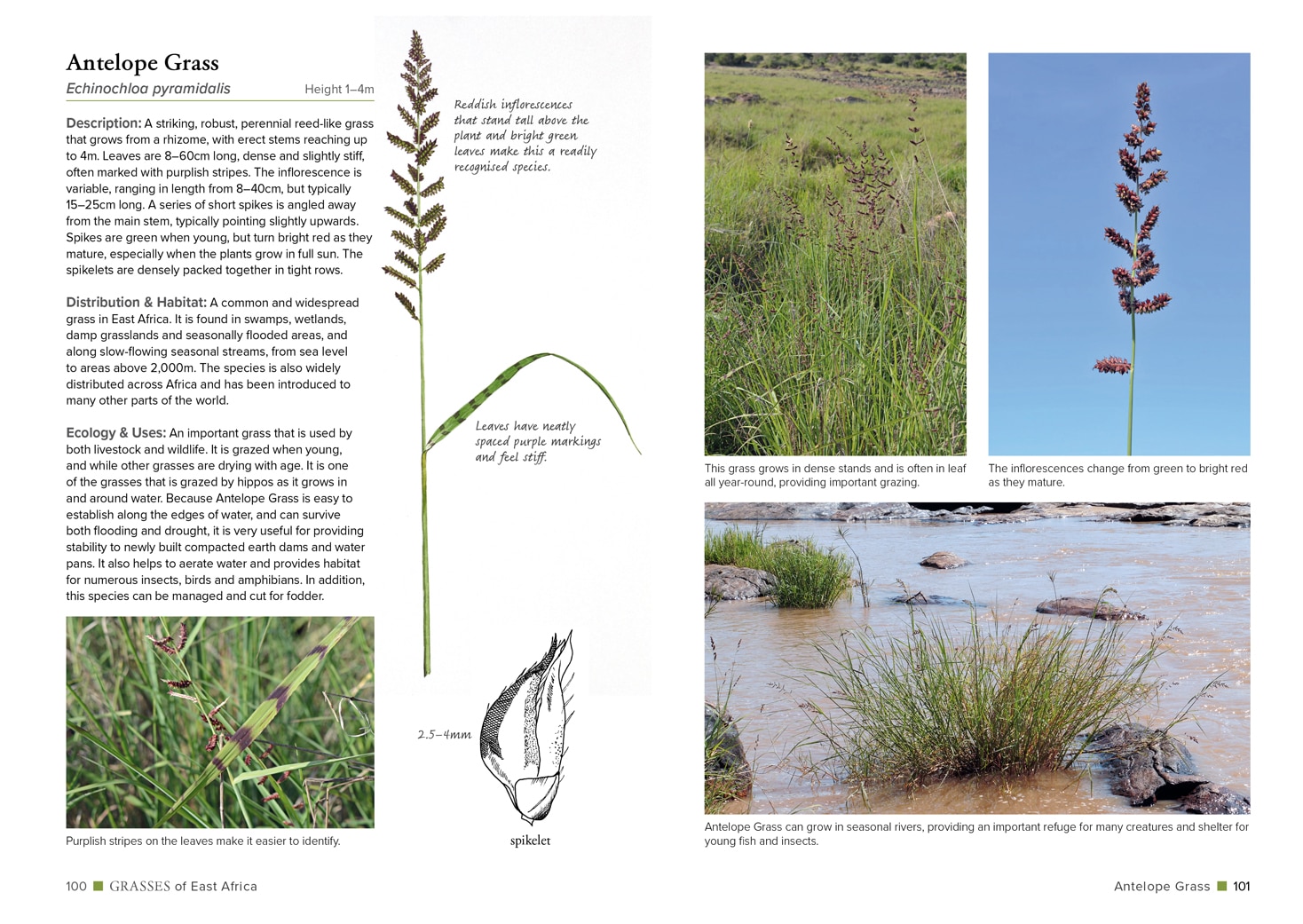
Grasses of East Africa describes 100 species of common, ecologically important or remarkable grasses found in Kenya, Tanzania, Uganda, Rwanda and Burundi. Grasses comprise one of the largest plant families on Earth, but are possibly the most overlooked. Yet it is these ubiquitous and important plants that have the greatest impact on our daily lives – providing a wide range of staple foods for humans globally, a fundamental source of grazing for livestock, and food and shelter for an infinite variety of wildlife.
In stock
Customer Reviews
There are no reviews yet.
Related products
-

Eerste veldgids: Bome van Suider-Afrika
R130.00Sasol Eerste Veldgids tot Bome van Suider-Afrika bied ’n fassinerende blik op die bome van die subkontinent.
Met behulp van volkleurfoto’s en verspreidingskaarte, asook maklik leesbare teks, sal die beginner en ontluikende natuurliefhebber die meer algemene bome in Suider-Afrika kan identifiseer, kan vasstel waar hulle groei, en meer te wete kom oor hul unieke eienskappe.
-

Field Guide to Renosterveld of the Overberg
R550.00Part of the Fynbos biome, Renosterveld is one of the world’s most threatened vegetation types, with just 5% of its original extent remaining. Focusing specifically on the Renosterveld of the Overberg region in the Western Cape, this field guide is the first of its kind to cover this highly endangered ecosystem, characterised by nutrient-rich soil which has been exploited for agriculture.
An in-depth introduction sets the scene, defining what Renosterveld is and giving some historical background to the ecology of the area.
The plants section follows, featuring over 980 plant species from the common and ‘showy’ to the weird, obscure and often-overlooked.
A shorter section of 140 animal species showcases the diversity of creatures found here despite severe habitat loss and fragmentation.
Additional features include a glossary with supporting illustrations, guidelines for landowners and farmers, and a comprehensive index.
Field Guide to Renosterveld of the Overberg promises to be an enduring record of this unique and severely threatened ecosystem. It will be a vital addition to any nature lover’s bookshelf. -

Nature Now Trees of Kruger
R290.00This book describes and illustrates 80 of the larger, more conspicuous and common tree species likely to be seen while travelling in South Africa’s Kruger National Park.
Intended as a handy guide to accurate identification, each spread shows the tree in full display along with a selection of supplementary images such as leaves, flowers, fruit and bark.
Succinct text with minimal botanical jargon supports the images, and informative boxes describe the uses of plant parts.
A series of maps demarcating 35 different vegetation zones or ‘landscapes’ within the Park helps readers to determine which tree species are likely to be seen in which area. -

Saunders Field Guide to Gladioli of Southern Africa
R580.00The genus Gladiolus has fascinated plant collectors, taxonomists and the general public for centuries. Known for their spectacular flowers, these highly adapted and specialised plants occur throughout Africa, Madagascar, Europe and the Middle East. South Africa is home to more than half of the world’s Gladiolus species and the Western Cape is the heart of species diversity. Saunders’ Field Guide to Gladioli of South Africa is the first of its kind to offer a complete photographic record of the 166 species that occur in the region. Posthumously completed, this book is the culmination of the Saunders’ long search to find and photograph every known species of Gladiolus in South Africa. It includes:
– An introduction comprising a brief history of gladioli, information about the morphology and taxonomy of the genus, and guidelines for use in the field.
– Detailed descriptions of the main floral parts of each species, along with information about ecology, pollinators, similar species and conservation status; field notes were written by Rachel Saunders.
– Over 1,000 exquisite photographs taken in situ detailing morphology and habitat.
– Up-to-date distribution maps indicating where species have been recorded.
– A glossary of terms with illustrations unpacking difficult terminology.
-

Wild Flowers of Namaqualand
R610.00Namaqualand is justifiably famous for the floral wonderland it becomes in spring, when seas of bright flowers carpet the land. Astonishingly, the carpet comprises some 3,800 species, of which 28% are endemic.
This book introduces nearly 600 species, highlighting those most commonly found, most conspicuous, spectacular or interesting, as well as endemics. An introduction touches on the species selection for the book, the climatic and topographical subregions within Namaqualand, plant names and uses, and conservation issues.
The concise species descriptions also give seed and fruit details, uses, local growing conditions and flowering times, along with beautiful full-colour photographs. This is a must-have guide for visitors to Namaqualand, or for anyone interested in the wild flowers of southern Africa.
-

100 Bushveld Trees
R390.00This highly visual new guide introduces readers to 100 of the most memorable trees in the bushveld – the northern and eastern regions of South Africa, encompassing both the lowveld and the highveld.
An introduction covers the basics of tree anatomy, supported by a pictorial glossary, and details the author’s streamlined ID method that enables even novices to make quick and sure identifications.
Most trees are generously featured across double-page spreads;
Full tree images along with diagnostic photos (bark, leaves, thorns, flowers, pods, fruit, etc.) enable readers to distinguish even those trees that are most confusing, such as the ‘acacias’ or the bushwillows;
Concise text highlights each tree’s key features;
Interesting facts, multiple uses and particular value the trees have among local populations are given.With its abundant, detailed photographs and straightforward text, this guide will help readers unlock the complicated world of trees.
-

Pocket Guide to Trees of Southern Africa
R280.00Southern Africa boasts a rich variety of tree species, both indigenous and exotic. Pocket Guide Trees of Southern Africa is an authoritative introduction to the region’s trees, describing and illustrating 132 species. This publication has its origins in Van Wyk’s A Photographic Guide to Trees of Southern Africa and has been fully revised and updated by well-known authority Braam van Wyk. Each species account highlights the key identification features, and also touches on the medicinal and commercial uses of the trees.
This compact, easy-to-use guide makes an ideal travelling companion and will help readers to become more knowledgeable about trees.
-

Plants of the Baviaanskloof
R560.00Tucked away in the southwestern corner of the Eastern Cape lies a narrow valley, flanked by the Baviaanskloof and Kouga mountain ranges. Named after the chacma baboons that long ago made this 200-km-long kloof their home, the Baviaanskloof is part of the Cape Floral Region World Heritage Site. It is a meeting point of several different ecosystems, with almost all of South Africa’s eight biomes represented, making for an exceptional diversity of species, including many endemics.
Plants of the Baviaanskloof describes well over 1,000 plant species. It includes:
– Succinct descriptions of each plant species with full-colour photographs
– Brief family and genus descriptions, and species counts for the area
– An introduction covering the geology, climate and vegetation types of the regionCompiled over two decades, Plants of the Baviaanskloof is sure to become an enduring record of the diversity of plant life found here. The only botanical guide for this area, it is a must-have for botanists, gardeners, road-trippers, hikers, travellers and all who have a deep interest in plants.
Be the first to review “Grasses of East Africa”
You must be logged in to post a review.