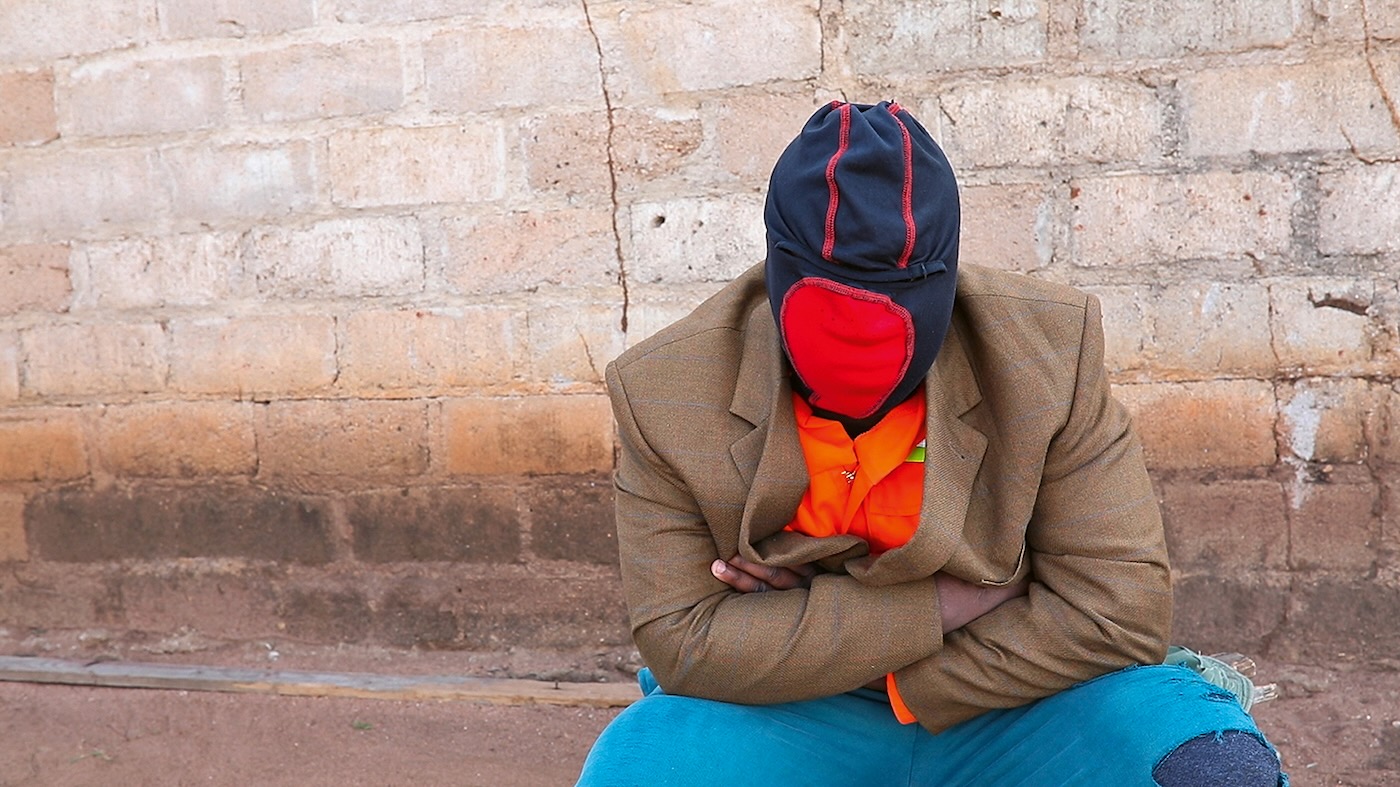
The photographer is Jonathan Wood. The poachers – for their protection because what they’re about to say could get them killed – we’ll name Money and Rabbit. Jono risked his life and visited them on and off for two years while shooting a documentary about their lives. It has yet to be assembled, and this is a small piece of a much larger whole. Until now he’s chosen to remain nameless for fear they could track him down. But for this book he’s prepared to risk it. Everything here can be corroborated with video and audio. This is his story.
We’re in a car, driving with poachers. Money is tall and skinny, rake-like. He drives. Rabbit is thick set and short. He sits in the passenger seat. They’re in masks. We see only eyes, only the side of a cheek, a scratchy beard.
A wintery landscape slides by – bony trees and blue sky. We’re up in the northern area of South Africa. Lowveld. It’s where the rhinos are. We’re driving alongside a farm.
“Our boss is dangerous. This needs to be between us,” Rabbit says. “If my boss found out I was doing this, selling information, my life would be over.”
“Bosses are too much dangerous,” Money adds. “If you go wrong, they kill you. A lot have been killed by their bosses. They have eyes everywhere.”
The car continues onwards. A haze of grey in the distance approaches. “Kruger National Park.” Money points.
“Once you pass the fence, they can shoot you,” Rabbit says. “In Kruger National Park those rangers kill you fast: black people kill black people. Because they give them R20,000 if they shoot you. People are scared now to go back inside.”
The landscape changes and is suddenly bright green. “We use the farm to enter,” Money says. “Mangoes. It is easy to go across the fence into Kruger, cut it, then come back here. And we can hide for a few days.”
Cut it. Poacher’s slang for cutting the horn off the rhino.
“If we go inside with tourists, they won’t be suspicious. We must look like we’re tourists,” Rabbit says.
“We’re dressed like you and then they drop us,” Money says. “The rangers are working with us. They leave our equipment inside. 458 and a Rambo to cut it. Big knife that one. Long handle. Two or three of us. One shoots, one cuts it, one puts it in the bag. It’s not dangerous if the rangers are with us.”