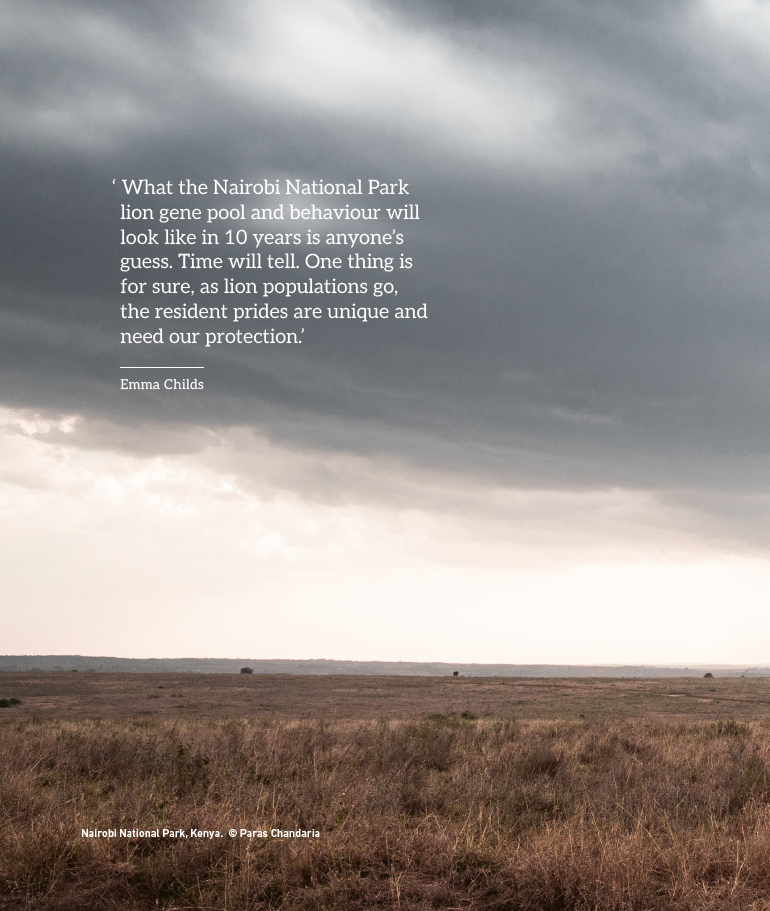
 Nairobi National Park is right up against a densely populated city, a situation to which both lions and humans need to adapt.
We have lived in different lion territories since 1997, all of which except one have bordered Maasai community land. The most extraordinary population of lions I have ever come across are those of Nairobi National Park. On one side, there is a densely populated metropolis with humanity right up against the borders, and on the other, an open area where for decades lions have moved freely through the southern conservation area: Nairobi National Park.
In each area we have lived, we’ve seen normal, standard lion behaviour. Of course, human–wildlife conflict has been rising and for the last few decades, lion populations have been on a downward trajectory. The Nairobi Park lions, however, are different in how they behave. Living alongside them on the border with the park over the past 11 years, I have been amazed at their level of adaptability.
Nairobi National Park was established in 1946 and is Kenya’s oldest park. Today, it’s fenced on three sides and the area where I live is an open boundary, the Mbagathi River being the line between community and wildlife.
When conservationist Mervyn Cowie, who was born in Nairobi, returned to Kenya in 1932 after a nine-year absence, he was alarmed to see the attrition of game animals on the Athi plains.1 Expanding farms and livestock had taken the place of the game. It was a paradise, he later recalled, that was quickly disappearing.
The area – which would later become Nairobi National Park – was part of the Southern Game Reserve. Hunting was not permitted, but nearly every other activity, including cattle grazing, dumping and even bombing by the Royal Air Force was allowed. Cowie campaigned for the establishment of a national park system in Kenya and the government formed a committee to examine the matter.
 Nairobi National Park was officially opened in 1946 – Kenya’s first national park – and Maasai pastoralists were removed from the area.2 Cowie was named as director and held this position until 1966. In 1989, Kenyan President Daniel arap Moi burnt 12 tonnes of ivory on a site within the park, hugely improving Kenya’s conservation and wildlife protection image.3
When I was growing up in Nairobi, my father would take me into the park and on these occasions, we rarely saw any cats and never rhinos. In the 1980s, the park was part of a much greater ecosystem that stretched into Amboseli and Tsavo, but, over time, this corridor has been closed as people have bought up land. The result is that we now have a pool of lions that have become ‘islandised’. Now and again new blood comes in but, generally, this population’s gene pool is shrinking.
A 2021 management plan for the park showed there were around 45 lions in an area of 114km2, with the population continuing to rise. In the 11 years of living on the border at The Emakoko lodge, we have seen the rise and fall of ‘great kings’, the rise and rise of female-dominated groups and the extraordinary behaviour of youngsters. There does not seem to be the stand-alone pride of more typical ecosystems, where one male dominates a femaleheavy group. Here, the population consists of female groups with males simply moving through.
My husband Anthony decided a lodge on the border of the national park would be a good idea and we hunted down a likely area for such a venture. Anthony camped for several nights along the border in the Maasai community zones until he found a spot that would tick all the boxes, including being off the flight path but with easy access to the main airport. In those days of camping, he spent many nights speaking to the community about conflict with wildlife. However, in the areas where he camped there appeared to be little, if any, wildlife. In most places, the nights were silent, then everything seemed to kick off between midnight and 04:00. Lion roars would come down the valley, no doubt accentuated by the valley acoustics. Occasionally, a stray lion would wander through and cause havoc with livestock, but this was relatively rare.
When we were putting the final touches to the lodge about a week before opening, we had our first encounter with lions. A building crew were cladding the lodge fireplaces and working day and night to finish on time. A couple of middle-aged lionesses decided to investigate, crossed the river and walked right into the lodge. Two builders came face to face with them in what is now the lounge area and hastily fled to join the rest of the crew, who were in other rooms. We all went back to investigate as it seemed unbelievable that two lions would just walk into a building full of people. Yet, there they sat, completely unperturbed. We decided to leave the evening to them and packed up. The Maasai night guard said they spent a good hour or two in the main areas the following morning before crossing back into the park.
 I had never before seen lions behave like that, but it appeared to be the norm in the area. The lions were absent during the day, but at night it was a different story – on many occasions I have chased off lions as I walk back to my house.
At one point, visits by lions became intense. We’d had a month of endless rain, and a lioness in the lodge grounds became marooned, with no way of getting back over the river into the park. We always slept with our doors open, our dogs serving as an early warning and deterrent. Late one night, the stranded lioness came right up to our house, probably starving and attracted by our baby who had been crying. Our ferocious Jack Russell, which slept at the end of my bed, was not going to take the intrusion lying down. She leapt out of the door into the jaws of the lioness, who was only about 30cm away. Sadly, our dog did not survive. We assumed the intruder was a leopard until we found the tracks the next morning. Over the next week, several dogs from the area were taken. Anthony tracked the lioness to where she had been hanging out just below the staff camp. Once the river receded, she made her way back into the park, but not before taking another two of our dogs. It was a hard lesson about the inappropriateness of keeping domestic animals in wildlife territory.
Perhaps having been squeezed out of a female pride, the lioness didn’t go far, making her home in the park just across the river, perhaps having acquired a taste for domestic animals. She later had cubs, which acquired the same taste, venturing onto community land and taking more than just the dogs. The lioness had to be captured and relocated to Tsavo East National Park.
Generally, though, human–wildlife conflict between lions and the community has been relatively limited. The rains have not been great, which means our big cats have had an easy life taking down drought-weakened prey. Conflict tends to happen when the community bring cattle into the park. Even bigger problems occur when the rains are good and the game moves out into the community land, followed by lions. Considering this, the community has been extremely tolerant, perhaps understanding that they and the lions share the park.
More recently, however, lions have been escaping the park in the other direction, perhaps because of internal conflict or maybe just curiosity. A large male lion was seen running through traffic along the Mombasa Road during rush hour, much to the horror of pedestrians. In the quiet, leafy suburb of Mukoma, a lioness ventured into gardens on more than one occasion until she, too, was darted and relocated to Meru National Park.
Over the years, our guides and guests have witnessed the rise and fall of dynasties. In 2021, we had our greatest loss when the magnificent Sirikoi had to be destroyed after shattering his jaw trying to get out of the cage while being taken to have an injury fixed. He was the son of the great Mohawk. They were two of the ‘great’ lions of this park that seemed to have ruled the area since the early 2000s.
As of 2023, we have six large male lions. They usually traverse the park using the roads and do not move aside for anyone. Two dominant males – Mpakasi who is just over 10 and Kitili who is about nine – have formed a coalition. Another coalition on the northern side of the park is between younger brothers Leshan and Quintai, and will most probably be the next force to be reckoned with when the Mpakasi kingdom falls. There’s a new and very young coalition on the southern side, and also two sons of Kitili, Elengat and Selengai, almost four years of age.
For the moment, though, the park belongs to Mpakasi and Kitili. They have ruled – in relative peace – since the death of Sirikoi. But trouble could loom up ahead from Elengat and Selengai as they seem to have closed off their area to the kings. In a fierce showdown, Mpakasi and Kitili were booted out of the southern area and chased back into the middle of the park. Will they continue to rule or will they fall? Despite Leshan and Quintai being next in line, they appear to have no interest in challenging anyone. As long as there is food and water, they have no loyalties to anyone and do not care who passes through their turf.

The largest pride is female dominated and lives around the lodge. There are two dominant females: Solo, who at 14 is one of the oldest lionesses in the park, and her niece Nala. They are a highly successful group, which includes six cubs. This pride is well known to the community around The Emakoko as they venture into the community land. However, they are well behaved and have no taste for livestock. From time to time we bump into these ladies in the lodge car park. Another nearby group consists of two females with three cubs, all of which seem shy and keep out of the way of Solo and out of the community.
The most commonly seen group of lions in the park are the Mpakasi and Kitili prides, consisting of four large females and 12 cubs of different age sets, ranging from three to eight months. They pose no threat to the community and tend to hang out in the ‘central district’ where the two kings frequently prowl. A few years ago, there was a bitter spat in the group when one of the youngsters decided to chat up the ladies. It quickly all went wrong. He was pounced on ferociously and had to scuttle off, tail between legs, gashed and bruised.
Towards the end of 2022, the drought hit the area very hard and rains that should have arrived in October finally fell at the start of December. The community had lost most of their cattle and whatever was left was moved out by truck to areas where there was grazing. The park was all that was left in the area with grass and, although dry, it was able to keep our migrant herbivores alive. By the end of the year, the buffalo herds had become large, some of them over 100 strong. Eland, impala, zebra and wildebeest grouped in large numbers in areas that contained the last vestiges of grazing. This abundant wildlife offered easy pickings for our feline friends and there has been little to no cattle–wildlife conflict in the area.
There is now talk of fencing the park but the community is fighting it as, in dry seasons, the park allows them to graze their cattle there, even if it’s illegal. However, wildlife services must provide compensation to the community for loss of livestock and it sees the cost of fencing the park to be the cheapest solution. A fence would also prevent wildlife from moving in and out of the park.
For more than 10 years we have been lucky enough to observe these incredible creatures from our refuge here at The Emakoko. Humanity has pressed in on every inch of the park, but these lions have adapted to the changing situation. Each generation that comes through seems to have updated their relationship. These big cats will continue to become more relaxed around people as long as they are not persecuted.
– Emma Childs

