Consider the elephant. Folklore might position the lion as king of the jungle, but elephants are the lords of Kruger. They’re also super smart; the world’s largest land mammal with three times as many neurons as us in their large brains. Neuron count is considered the best predicter of the mental power of a species, so what are elephants doing with all that brainpower?
Let’s begin with the trunk. It’s an extraordinarily sensitive smelling, grasping and feeling organ with about 40,000 muscles co-ordinated by a unique nerve that runs along its full length. It can suck up eight litres of water and blast it at an annoying hippo, but at the tip are two sensitive ‘fingers’ that can pick up things as small as a blade of grass. In the same way we have handy intelligence with opposable thumbs, elephants have ‘trunky’ intelligence.
In many ways they’re like us, in many other ways it would be better if we were more like them. They form close family groups that last a lifetime, are extremely protective of their young, are peaceful unless threatened and mourn their dead. They play, they stroke each other at every opportunity and bathe often. Their only predators are drought – and us. Therein lies a problem. In a safe park with good water, they can breed like rabbits.
Kruger’s elephant carrying capacity is the subject of constant debate. It’s not known how many lived in the Lowveld before humans developed the capacity to hunt them, but that’s relevant for how many there should be now. By 1900 almost all had been shot out and only in the 1960s did their numbers begin to rise. By 1967 there were around 10,000 and it was arbitrarily decided that 7,500 was an appropriate number – one elephant per square mile. Culling began. By the time it ended in 1994 due to pressure from conservation groups and changes in management strategy, 14,500 elephants had been killed.
Numbers began to rise immediately culling ended. By 2025 there were around 31,000, which led to the reintroduction of debates about how many elephants there should and could be in the park.
Back in 2005 a group of elephant scientists met in an attempt to solve this and came up with three questions:
Are there too many elephants?
Are elephants causing irreversible damage to Kruger’s biodiversity?
Is action needed to reduce elephant densities?
None have yet been answered and in some forums the differences have reached shouting level. Everyone has a position.
Have a look inside Kruger Speaks
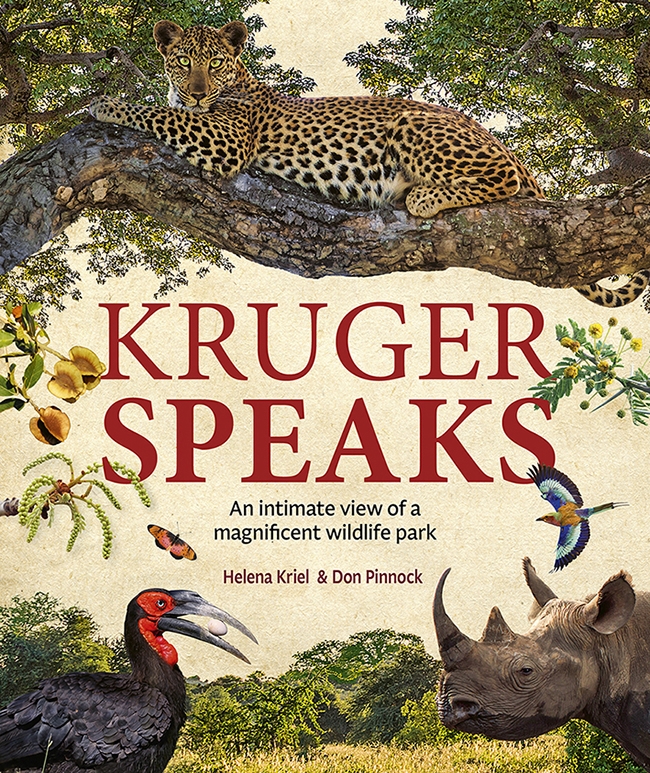
Kruger Speaks
Across nearly 20,000 square kilometres of ancient land, Kruger National Park reveals itself not as a destination, but as a living, breathing presence. In this extraordinary book, the park speaks through a chorus of voices: rangers, scientists, workers, travellers and the wildlife and landscape itself.
From the slow rhythm of a dawn drive to the magnetic silence of a riverbank, each page invites you deeper into a world where elephants shape landscapes, antelope sustain entire ecosystems and birds carry echoes of deep time. Through intimate interviews and vivid storytelling, the hidden life of the park emerges: the dedication of those who protect it, the complexity of conservation, the rough lives of the poachers who plunder it and the ever-present tension between sanctuary and survival.
Accompanied by striking photography, Kruger Speaks captures both the grandeur and the subtlety of one of Earth’s last great wild places.